
diagnostic testing lims
Designed for the Complexity of Modern Diagnostic Testing
From high-throughput molecular workflows to evolving assay requirements, diagnostic labs face increasing complexity that demands a connected system built to adapt. Labbit's graph-native architecture preserves the relationships between samples, workflows, instruments, and results, allowing teams to evolve without sacrificing control, traceability, or compliance.
Trusted By






Why Diagnostic Testing Labs Need a LIMS Built on Connected Data
Diagnostic testing workflows rarely follow a single, linear path. Different sample types, assay methodologies, branching workflows, bioinformatics analysis, and evolving test menus create a web of interconnected information that must remain intact from accessioning through reporting. Managing that complexity requires more than storing data, it requires preserving the relationships behind every result.
Labbit's graph-native architecture captures those relationships by design, giving teams immediate access to complete sample-to-result provenance and the confidence to support clinical decisions, investigations, and regulatory expectations.
Key Benefits for Diagnostic Testing Labs
Complex Workflows, Modeled Natively
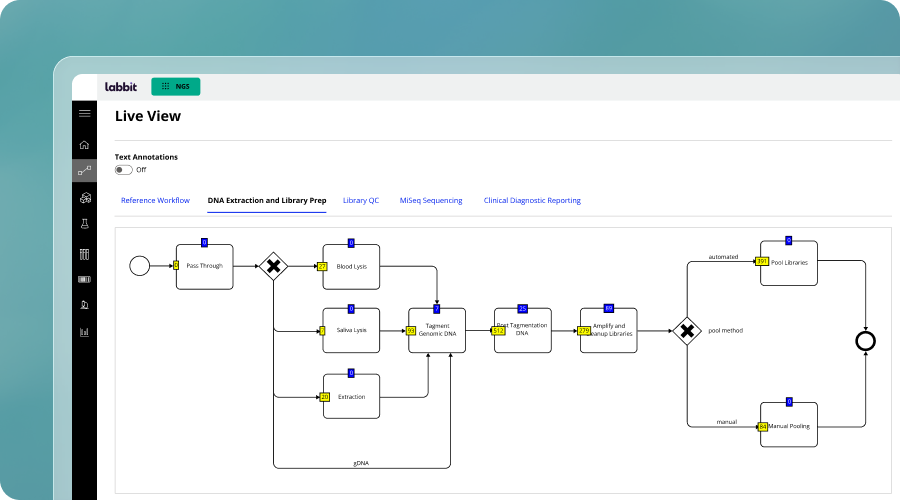
Build your lab’s complex reality into Labbit using highly visual, AI-assisted BPMN-based configuration that captures every step, decision, and workflow path—no coding, no workarounds.
Faster Change Deployment
Adapt workflows faster while maintaining control, compliance, and system stability with Labbit’s built-in version control that provides full visibility into what changed to scope and accelerates revalidation.
Increased Accuracy & Efficiency
Automate repetitive tasks and data capture with Labbit's workflow engine and robust integrations. Keep data flowing and processes running consistently to improve integrity, reduce errors, and accelerate turnaround times.
Audit-Ready by Design
Embed compliance directly into workflows and enforce steps in alignment with CLIA, CAP, and FDA requirements. Every event is captured in fully traceable audit trails so you can confidently answer auditor questions and demonstrate compliance.
Performance That Scales
Scale testing volumes, expanding test menus, and laboratory operations with a flexible, cloud-based platform that adapts to changing demands without sacrificing performance, traceability, or data integrity.
Complete Sample Provenance
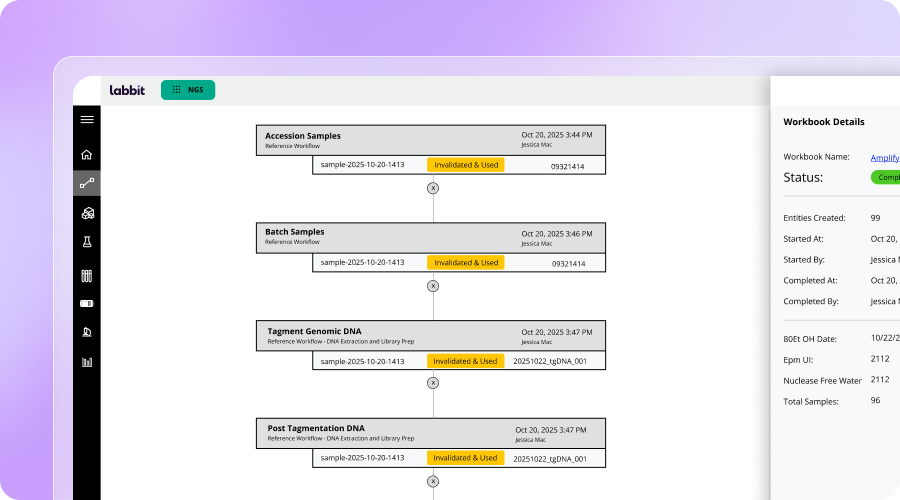
Trace every result back to its originating sample, workflow version, instrument, analyst, and supporting data. Labbit's graph-native data model preserves these relationships by design, making complete provenance instantly accessible—not reconstructed.
Supporting the Complete Diagnostic Testing Lifecycle
pre-analytical
Complete Accuracy From Accessioning to Assignment
Standardized digital order forms and required field enforcement capture complete, accurate sample and assay information from the very start. Orders are automatically routed to the correct testing workflow, carrying pre-analytical data through each subsequent step to maintain complete sample context throughout the testing lifecycle.
analytical
Every Step, Exactly to Protocol
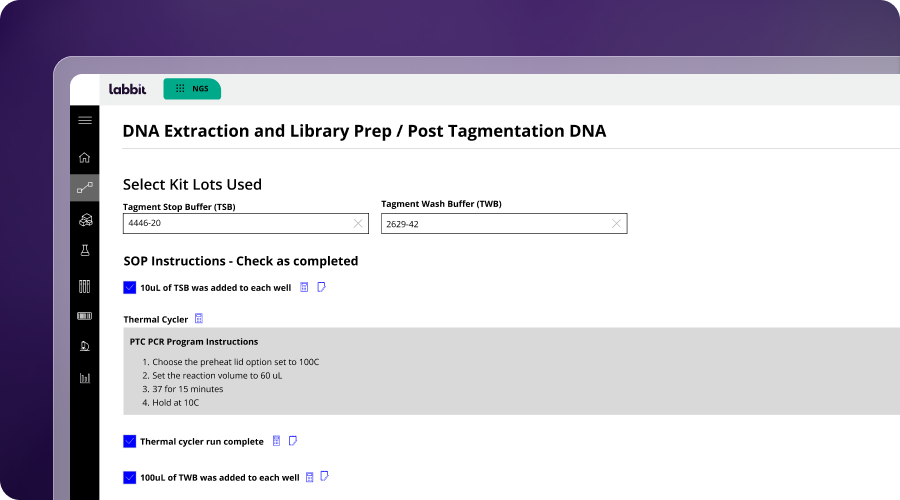
Labbit can be configured around your exact SOPs to guide bench work precisely, step-by-step through analytical procedures, whether preparing samples for sequencing or performing PCR-based and other molecular assays. Data is captured directly from connected instruments to streamline the analytical stage while ensuring every action remains fully traceable.
post-analytical
End-to-End Traceability for Faster Review & Reporting
Results, including bioinformatics analysis and variant calls where applicable, are captured against workflow and method, with every entry attributed to a user and timestamped at creation. Labbit enforces your review and approval steps before a result can be reported, automatically routing each result to the right reviewer to keep turnaround time on track.
quality control
Detect Issues Earlier & Investigate Faster
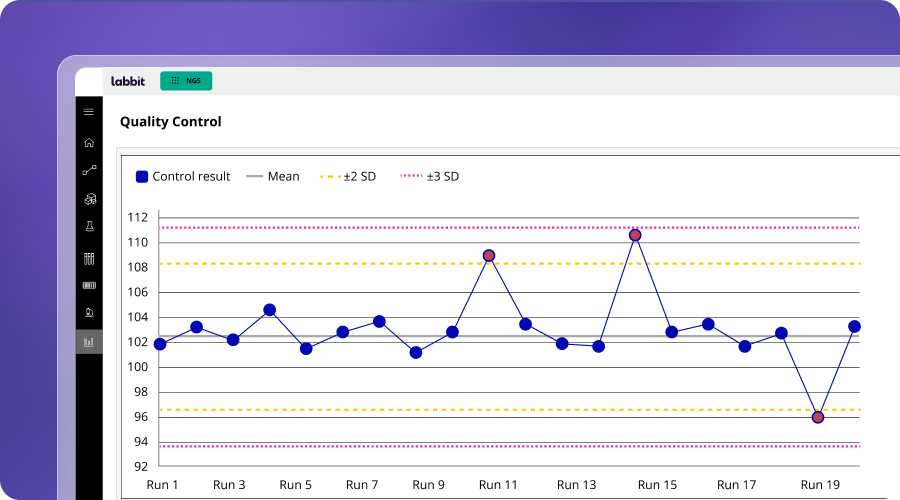
Failed QC events, repeat testing, and flagged results move into a structured investigation path inside Labbit, connecting the flagged result directly to instrument history, reagent lots, and prior testing so root-cause analysis doesn't require piecing together information from separate systems. Built-in dashboards also surface QC trends and recurring investigation patterns across runs, giving your team visibility to catch issues before they affect additional samples.
Explore Key Features for Diagnostic Testing Labs
Complex Workflow Configuration
Visually model complex lab workflows with precision, capturing every step, decision, and dependency exactly as they operate in reality.
Real-Time Lab Monitoring
Monitor every sample, run, and workflow in real time with an interactive view of laboratory operations, making it easy to identify bottlenecks before they impact turnaround times.
Inventory & Instrument Tracking
Track reagent inventory, consumables, and instrument readiness to avoid delays, support testing continuity, and ensure assays are performed with qualified equipment.
Configuration Version Control
Maintain a complete history of every workflow and assay configuration change, with version comparisons that simplify review, validation, and controlled deployment.
Context-Rich Audit Trails
Automatically capture immutable records of every event with full context so you can answer auditor questions quickly and with confidence.
eSignatures & Approval Workflows
Enforce role-based sign-off at each review step, with electronic signatures backed by real-time authentication.
Customer Spotlight
Helix
“As we look ahead, we’re always asking how quickly we can iterate—how quickly we can release updates to a workflow or create new ones. Labbit is a key part of that, enabling us to test, validate, and bring new workflows into production more efficiently.”
Tyler Cassens
Senior Product Manager, Helix
Related resources
Insights for Modern Diagnostic Testing
Browse articles, webinars, and whitepapers that explore how modern laboratory informatics helps diagnostic testing teams maintain compliance, manage change, and build more connected operations.
Blog
The Best LIMS for Regulated Labs
The right platform isn't the one with the longest feature list, it's the one that aligns with your lab's workflows, data model, regulatory requirements, and stage of growth.
Whitepaper
RDF Knowledge Graph Databases
Discover why a LIMS built on a graph database is a better choice for life science laboratories.
Use case spotlight
Scaling Precision Diagnostics
Discover how a precision diagnostics company implemented Labbit in time for CLIA/CAP accreditation while building a scalable laboratory foundation capable of supporting complex workflows, machine learning, and future growth.
Webinar
Configuration Versioning for LIMS: Bringing Software-Style Releases to Laboratory Systems
LIMS updates are often slow and complex. Learn how versioned changesets enable faster, controlled configuration releases.
REGULATORY COMPLIANCE + DATA SECURITY
Traceability and integrity by design
Labbit provides complete visibility across workflows with immutable audit trails and full traceability of every action and system change—so you can operate with confidence and control. Built on secure, cloud-based infrastructure with role-based access controls and SOC 2 Type II accreditation, Labbit ensures your data remains protected while maintaining the integrity and transparency required in highly regulated lab environments.

Getting Started
See how Labbit works for labs like yours
Book a 30-minute demo to see visual workflow modeling, real-time execution visibility, and knowledge graph insights in action. We'll show you how Labbit adapts to your specific workflows — without the vendor lock-in.