
The best LIMS for quality, manufacturing, and development teams depends on the lab’s needs, stage, and science: whether that means a workflow-first system like Labbit for complex, evolving operations, an enterprise platform like LabVantage for more standardization, or an ELN-centered system like Benchling for teams prioritizing research documentation.
Choosing the right LIMS does not mean selecting the platform with the most features. Rather, teams should seek a system that can match the complexity of the lab’s science without adding unnecessary overhead:
- Flexible enough to model evolving workflows
- Structured enough to preserve data context
- Controlled enough to support evolving regulations.
Top LIMS for regulated labs at-a-glance
This guide lays out recommendations for how to choose the right vendor for your lab’s workflows as more teams invest in informatics. Here is a quick summary of the findings:
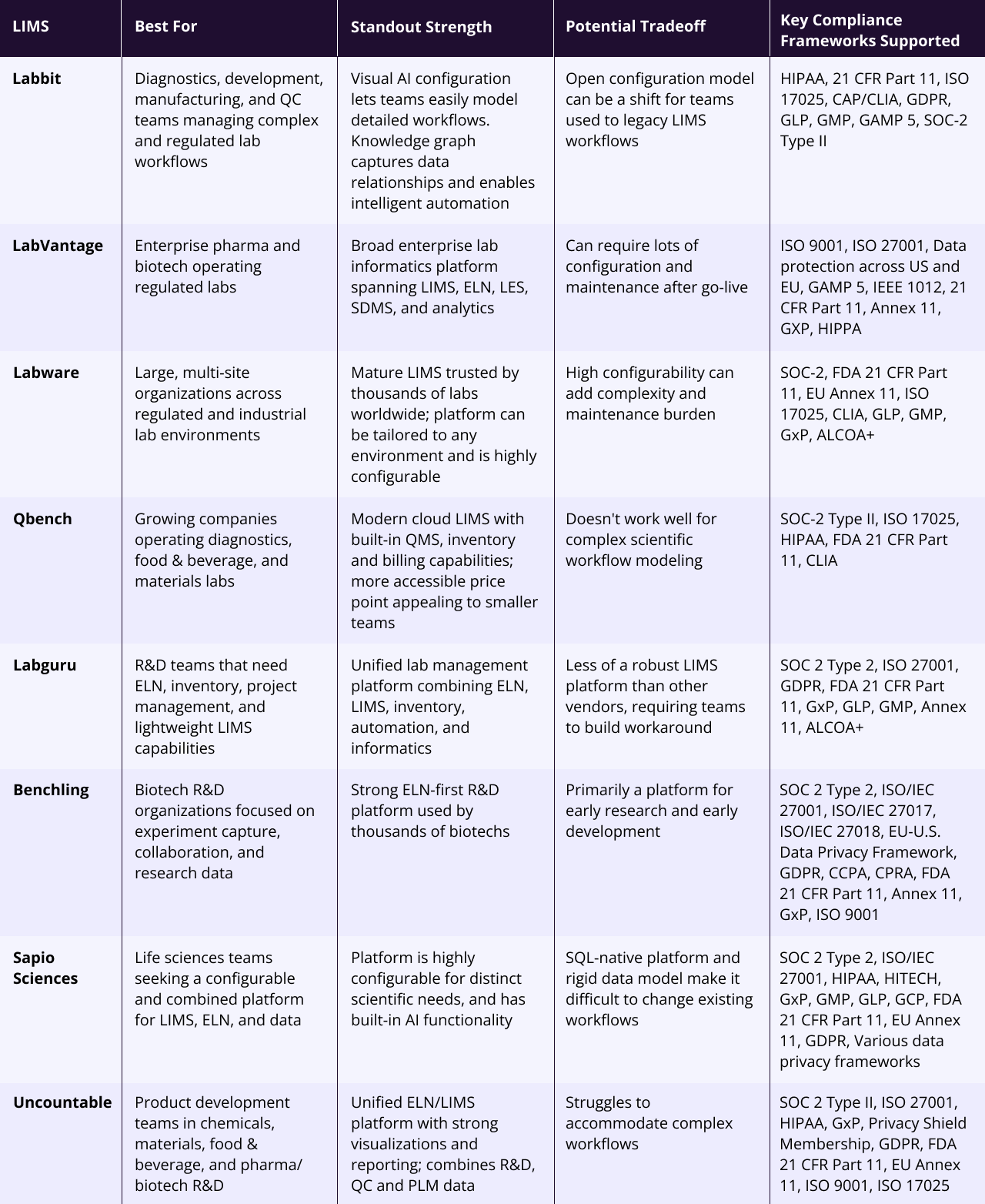
Before diving deeper into the rankings in this guide, it’s important to define what “best LIMS” actually means regulated labs.
What workflow, sample tracking, and data management capabilities should a LIMS have?
- Teams can configure and deploy regulated workflows in multiple formats. The system makes it easy to iterate on protocols as the science evolves.
- Every sample is traceable, with complete chain of custody and a clear record of how the sample moves through each workflow.
- Lab data is findable, accessible, interoperable, and reusable (FAIR). This makes data easier to search, report on, audit, and use as a foundation for AI.
What operational capabilities should a LIMS include?
- The system supports inventory management by tracking reagents, consumables, supplies, lots, expiration dates, storage locations, and usage across workflows.
- The system integrates directly with lab instruments and analysis tools, enabling bidirectional data exchange and reducing manual transcription.
- The system captures key details across samples, inventory, instruments, locations, and workflows, so teams can trace how work moves through the lab from start to finish.
- The LIMS is fast to implement and easy to maintain
What compliance features should a LIMS for regulated labs support?
- The LIMS includes audit trails, permissions, versioning, electronic signatures, controlled workflow changes, and compliance-ready reporting.
- Data, workflows, samples, instruments, and materials stay connected as protocols and processes evolve.
- The system can support development, manufacturing, QC, molecular diagnostics, cell and gene therapy, and other regulated environments, with capabilities aligned to HIPAA, 21 CFR Part 11, ISO 17025, CAP/CLIA, GDPR, GLP, GMP, and GAMP 5 requirements.
With those criteria in mind, the ranking below compares where each LIMS fits best, what each platform does well, and what buyers should consider before making a decision.
Ranking the best LIMS for Regulated Labs
#1 - Labbit
- Labbit is a modern LIMS built for complex, evolving lab workflows. The platform combines workflow configuration, sample tracking, instrument monitoring, and data management into one system, helping labs easily model, run, and adapt operations as science changes.
- Best for companies in molecular diagnostics, chemicals/materials, and cell & gene therapy seeking a modern LIMS to accommodate complex workflows across process development, manufacturing, and QA/QC
- Strengths
- - Combines core lab operations in one platform, including workflow configuration, sample tracking, inventory management, instrument monitoring, order processing, and data management.
- - Visual, no-code workflow configuration helps teams define complex multi-step workflows without relying on heavy custom development.
- - Structured data management through a unified knowledge graph makes lab data easier to find, access, report on, and provides a strong foundation for AI use.
- - SOC 2 certified and supports compliance with HIPAA, 21 CFR Part 11, ISO 17025, CAP/CLIA and GDPR
- Potential tradeoff
- - Labbit’s open, workflow-first configuration model gives teams more control, but it can be a new way of working for organizations used to vendor-led LIMS changes or heavily scripted customization.
- - Organizations looking for a highly structured enterprise LIMS may prefer a more traditional legacy platform.
- - Labbit is most directly aligned to complex scientific environments in industries like molecular diagnostics, cell and gene therapy, and chemicals/materials. Teams in more routine or highly standardized settings may not need the same level of flexibility.
- Bottom line: Labbit is the strongest fit for regulated labs that need a LIMS to match complex, evolving science: flexible enough to adapt workflows and structured enough to ensure compliance and preserve data context as requirements change.
#2 - LabVantage
- LabVantage is a long-standing LIMS and laboratory informatics platform used across regulated lab environments. Its platform spans LIMS, ELN, LES, SDMS, and analytics capabilities.
- Best for: Enterprise pharma, biotech, QC, diagnostics, and regulated lab environments that need a mature LIMS platform with broad functionality and strong industry recognition.
- Strengths
- - Broad lab informatics platform with LIMS, ELN, LES, SDMS, and analytics capabilities available through one vendor.
- - Strong fit for regulated enterprise environments that need sample management, testing, storage, quality, reporting, and operational control.
- - Established presence in pharma, biotech, diagnostics, QC, and other regulated lab settings.
- - Can support complex infrastructure and customized workflows, especially for teams with dedicated internal LIMS/admin resources or implementation support.
- Potential tradeoff
- - LabVantage’s breadth and proprietary code makes implementation and long-term administration more involved, requiring teams to work with LabVantage’s own specialists.
- - Highly specialized or frequently changing workflows require more configuration effort after go-live.
- - Some capabilities are not part of base implementation and require additional configuration
- Bottom line: LabVantage is a strong choice for enterprise teams that want a mature, broad laboratory informatics platform and have the resources to support a more involved implementation and admin.
#3 - Labware
- LabWare is one of the most established LIMS vendors in the market, with broad adoption across regulated and industrial lab environments.
- Best for large organizations that need a highly configurable enterprise LIMS across multiple sites, business units, industries, or lab types.
- Strengths
- - Strong brand recognition and long-standing presence in the LIMS category.
- - Broad industry footprint across biopharma, diagnostics, food and beverage, chemicals, environmental testing, manufacturing, and other lab settings.
- - Highly configurable platform that can be tailored to meet a wide range of lab requirements.
- - Mature suite of lab automation capabilities, including LIMS, ELN, mobile, and AI-related functionality.
- Potential tradeoff
- - LabWare’s high configurability adds complexity, particularly when custom scripting or specialized implementation resources are required.
- - Heavy customization can make future updates, workflow changes, and upgrades more involved.
- - The platform typically requires dedicated internal IT, administrator, or partner support to maintain over time.
- - Rapid workflow iteration becomes harder when process changes depend on deep configuration or coding.
- Bottom line: LabWare is a strong fit for large, multi-site organizations that need a mature and highly configurable LIMS and have the internal or partner resources to manage that flexibility over time.
#4 - Qbench
- QBench is a modern and highly flexible cloud-based LIMS. The platform includes LIMS, QMS, inventory management, billing, and a customer portal.
- Best for: growing commercial, testing, diagnostic, food and beverage, agriculture, environmental, or materials labs that want a modern cloud LIMS with strong operational features.
- Strengths
- - Modern, cloud-based LIMS with an approachable user experience.
- - Strong fit for sample-centric workflows, order tracking, reporting, and operational lab management.
- - Integrated QMS, inventory, billing, and customer portal capabilities help connect lab operations with customer-facing workflows.
- - Flexible enough to support customized reports, workflows, worksheets, labels, and operational processes.
- Potential tradeoff
- - Workflow configuration can be very complex and require JSON knowledge. Advanced workflow configuration requires more technical setup for non-linear or highly specialized processes.
- - Some capabilities depend on package tier, configuration, or add-on modules.
- - Sophisticated storage, location hierarchy, or inventory workflows require careful scoping during implementation.
- Bottom line: QBench is a strong option for labs that want a modern, cloud-based operational LIMS with quality, billing, customer portal, and sample-tracking capabilities, especially when workflows are relatively structured and sample-centric.
#5 - Labguru
- Labguru is a cloud-based lab management platform that combines ELN, LIMS, inventory management, automation, and informatics capabilities.
- Best for: Smaller biotech, pharma, academic, or R&D teams that need an ELN-centered lab management system with inventory, sample tracking, project management, and lightweight LIMS capabilities.
- Strengths
- - Strong fit for R&D environments where teams need to plan experiments, document procedures, manage projects, and organize scientific knowledge.
- - Combines ELN, LIMS, inventory, automation, and informatics in one lab management platform.
- - Useful for biotech and pharma research teams that need research documentation plus operational lab management support.
- - Practical fit for smaller teams that want an approachable system without the cost or complexity of a full enterprise LIMS.
- Potential tradeoff
- - Labguru is strongest as an ELN-centered research lab management system, not a deeply complex LIMS.
- - Not a good fit for clinical, manufacturing, or highly regulated environments that require more robust order management, patient/sample tracking, chain of custody, and audit controls.
- - Workflows outside biotech and pharma R&D require more customization.
- - Highly customized workflows are more limited than other LIMS.
Bottom line: Labguru is a good fit for R&D-focused teams that want an approachable ELN and lab management platform, but it may not be the best fit when the primary need is complex operational LIMS execution.
#6 - Benchling
- Benchling is a cloud platform for biotech R&D, serving over 1,200 biotech organizations. Benchling primarily focuses on discovery, development, and scientific collaboration use cases.
- Best for: Biotech R&D organizations that need an ELN-centered platform for experiment capture, scientific collaboration, registration, and research data management.
- Strengths
- - Strong reputation and market presence in biotechnology R&D.
- - Large customer base, with more than 200,000 scientists across 1,200+ biotechs using the platform.
- - Strong ELN and collaboration capabilities for research and development teams.
- - Useful for teams that need to document experiments, manage biological entities, organize R&D data, and collaborate across scientific groups.
- Potential tradeoff
- - Benchling’s strength is R&D documentation, collaboration, and scientific data management; operational LIMS execution is not its primary fit.
- - Teams moving from research into development, production, or regulated lab execution often need capabilities beyond an ELN-first platform.
- - As an ELN-first solution, Benchling doesn’t have robust sample history and chain-of-custody tracking nor fully built out LIMS operational capabilities. The platform lacks comprehensive workflow orchestration such as handoffs and automated routing.
- Bottom line: Benchling is a strong choice for biotech R&D teams, especially when the primary need is an ELN and scientific collaboration platform. Labs that need rigorous operational workflow execution likely require more LIMS-native solutions.
#7 - Sapio Sciences
- Sapio Sciences is a lab informatics platform that combines no code LIMS and ELN. They also offer an AI lab notebook and scientific data cloud.
- Best for: Life sciences organizations that want a broad, configurable lab informatics platform spanning LIMS, ELN, scientific data management, AI, and scientific workflows.
- Strengths
- - Strong life sciences focus across biotechnology, pharma, clinical diagnostics, and related scientific environments.
- - Configurable, no-code LIMS positioning for complex processes, workflows, sample management, compliance, and automation.
- - AI-powered lab assistant provides scientists the ability to interact with the system through natural language prompts, streamlining various lab tasks
- Potential tradeoff
- - Sapio’s broad platform scope requires teams to do more configuration and implementation design work upfront. The final system experience depends heavily on how well scientific and operational requirements are captured during implementation.
- - As a SQL-based LIMS, Sapio can be less flexible when teams need to make frequent changes, because the system depends on predefined data models.
- - Some capabilities come through configuration, add-on packages, or services rather than being immediately available out of the box.
- - For teams that only need a focused LIMS, the broader LIMS/ELN/scientific data platform can be more expansive than necessary.
- Bottom line: Sapio Sciences is a strong option for teams that want a configurable life sciences informatics platform with LIMS, ELN, scientific data management, and AI capabilities, especially when they are looking for a broad system rather than a focused LIMS.
#8 - Uncountable
- Uncountable is a cloud-based laboratory informatics platform built for enterprise R&D and product development teams. The platform combines ELN and LIMS capabilities with experiment documentation, sample and material tracking, data visualization, reporting, and AI/ML capabilities.
- Best for: Enterprise R&D organizations in chemicals, materials, and food & beverage manufacturing that need a unified ELN/LIMS platform for experiments, formulations, and reporting.
- Strengths
- - Combines ELN and LIMS capabilities in one platform for process development teams; connects data across R&D, QC, and PLM.
- - Strong fit for formulation-heavy environments, especially chemicals, materials, and food and beverage.
- - Built-in visualization, analysis, and reporting tools help teams compare experiments and make sense of data.
- Potential tradeoff
- - The platform’s depth and customization can create a learning curve, especially for teams looking for a more turnkey or intuitive user experience.
- - Teams working with large datasets or complex reporting needs may run into performance and usability issues.
- - Workflow execution is less central to Uncountable’s platform than experimental documentation and reporting.
- Bottom line: Uncountable is a strong option for teams that want a unified ELN/LIMS platform with robust data visualization and reporting. Teams whose primary need is complex, regulated workflow execution may need a more workflow-first LIMS.
Which LIMS is best for your regulated lab?
With so many informatics vendors on the market today, the best LIMS depends on your lab’s workflows, data model, regulatory requirements, and stage of growth. Enterprise teams with standardized, multi-site operations may gravitate toward established platforms like LabVantage or LabWare, while R&D-focused teams may prioritize ELN-centered systems like Benchling or Labguru.
For regulated labs managing complex, evolving science across development, manufacturing, and QC, Labbit is designed for a different need: starting with how your lab actually works, and enabling teams to model workflows without code, adapt as science changes, and preserve full data lineage from start to finish. If your lab has outgrown rigid workflows, fragmented data, or vendor-dependent configuration cycles, schedule a demo of Labbit LIMS today.