Labbit vs Sapio Sciences

Trying to determine the right fit for your lab?

Both platforms cover the core capabilities of modern laboratory informatics, but they're built on fundamentally different architectures. Those architectural decisions influence how closely a LIMS can reflect your laboratory's operations, how easily it can evolve over time, and how much effort it takes to maintain in regulated environments.

This page explores where those differences matter in more detail.

LABBIT VS Sapio

A Side By Side Comparison

How architectural decisions shape a lab's ability to adapt workflows, manage change, maintain compliance, and support advanced analytics.

Sapio

Platform Origins

Originally developed as an ELN, with LIMS capabilities added over time. The platform’s strengths reflect that lineage, particularly in research documentation and experiment management.
Purpose-built as a LIMS, with workflow configuration, sample management, and traceability as foundational design elements.

Data Model Flexibility

SQL-based architecture organizes data into structured tables and schemas. For labs with stable, well-defined workflows, this works well, though adapting the data model as scientific needs evolve requires more deliberate effort.
Graph-native architecture captures entities, attributes, and relationships as first-class data. Labs can extend data models and adapt workflows as science evolves — no schema restructuring required.

Change Management

Relationships between data, workflows, and results aren't natively connected. Understanding the full impact of a configuration change requires additional effort to trace what was affected.
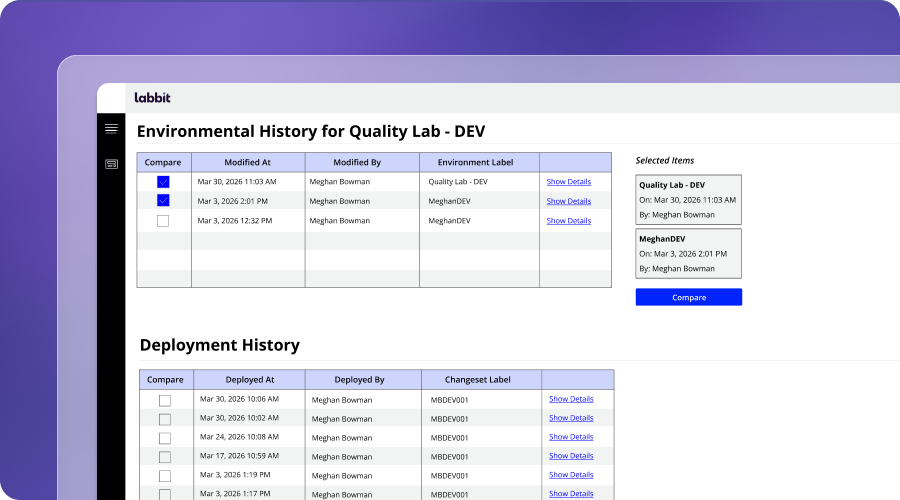
Configuration is versioned and change histories are tracked automatically. Quality and validation teams can see exactly what changed and limit revalidation scope to only the affected areas.

Data Storage & Querying

Relational architecture organizes data into structured tables. Querying across samples, workflows, and results is handled through joins across those tables.
Graph-native architecture stores relationships natively, making queries across samples, workflows, results, and metadata fast by design.

Regulatory Compliance

Audit events are recorded at the table level. Assembling a complete sample history across workflows and results requires querying across those tables.
Graph-based architecture automatically captures all data and relationships in immutable, audit-ready records. Complete sample lineage is always available and instantly traversable.

Why do labs choose Labbit over Sapio?

Easily configured to how your lab actually works

Labbit's native knowledge graph architecture and no-code BPMN workflow engine allow workflows, data models, and relationships to be configured around your laboratory's unique processes—no matter how complex—without workarounds, custom code, or compromises to fit the software's preconceived notion of how a lab should operate. The result is a LIMS that accurately reflects the reality of your laboratory, not a generic approximation of it.

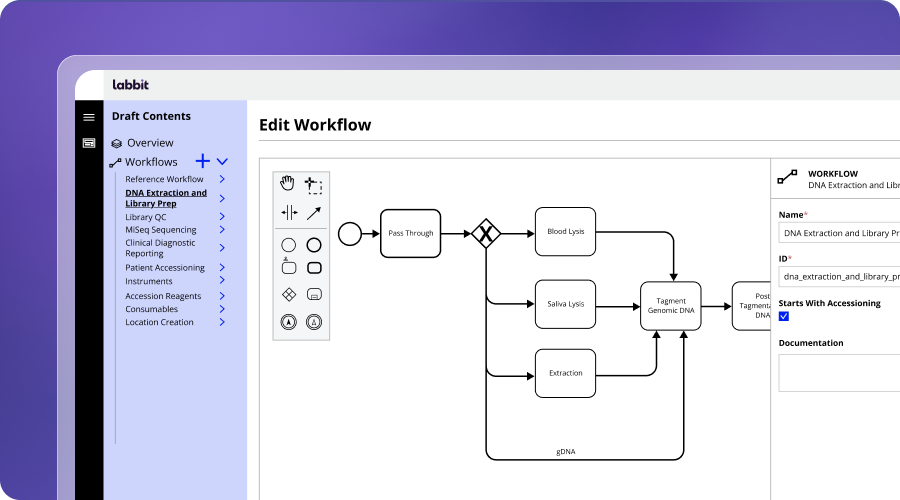
User interface of Labbit showing an Edit Workflow screen with a DNA extraction and library preparation workflow diagram including steps Pass Through, Blood Lysis, Saliva Lysis, Extraction, and Tagment Genomic DNA.

Lower maintenance overhead by design

Implementing a LIMS is only the beginning. The real cost comes from maintaining it as your laboratory evolves.

Labbit is designed to reduce that long-term maintenance burden. Its no-code configuration and version-controlled change management allow laboratory teams to continuously update workflows as processes evolve without relying on IT resources or developers for every change. Every configuration update is versioned, making it easy to understand what changed, assess the impact on validation, and focus revalidation efforts only where they're needed. The result is a LIMS that evolves with your laboratory while keeping IT involvement and ongoing maintenance to a minimum.

Built by LIMS implementation experts

Software alone doesn't guarantee a successful implementation.

Before developing Labbit, the team spent decades implementing LIMS as Semaphore Solutions, helping complex laboratories configure and optimize systems across regulated industries. Those experiences exposed the limitations of traditional LIMS platforms and directly informed how Labbit was designed, from flexible workflow configuration and graph-native data modelling to sustainable change management and validation. Today, customers benefit from a platform built by people who've spent years implementing laboratory systems, not just developing them.

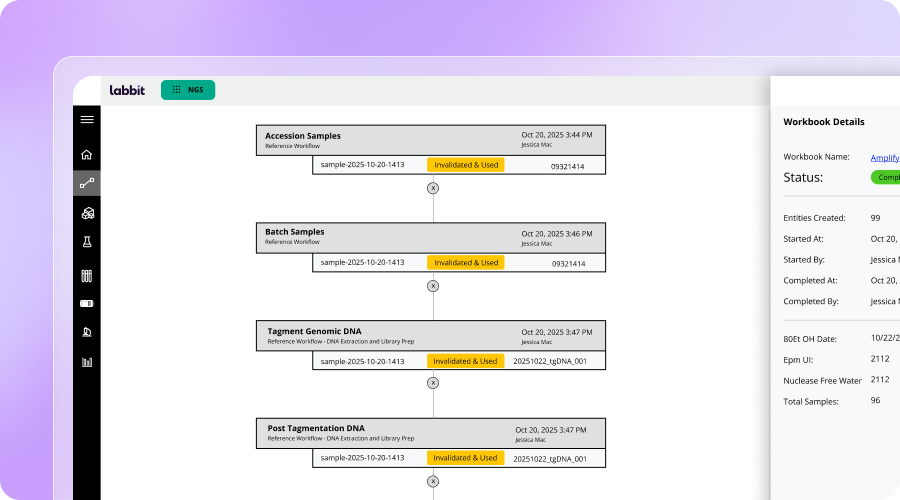
Workflow dashboard showing sample audit trails with status 'Invalidated & Used' listed under accession, batch, tagment genomic DNA, and post-tagmentation DNA samples, alongside workbook details and status marked complete.

"When we saw how Labbit works, it was clear how thoughtfully they built the system to address the challenges their customers had encountered with other LIMS."

John ten Bosch
VP of Laboratory Operations, BillionToOne

"With a Next-Generation LIMS like Labbit, the high amount of money and effort ultimately wasted when a LIMS solution never gets deployed or adopted may become a problem of the past."

John Conway
Chief Visioneer, 20 / 15 Visioneers

“Labbit empowered us to transcend the traditional trade-offs between advanced features the commercial side of the business wants and the user experience that our laboratorians require.”

Ronak Kadakia
COO, LinusBio

“That’s what stood out when evaluating Labbit—that this LIMS could finally achieve all of our needs with one solution.”

Tyler Cassens
Senior Product Manager, Helix

getting started

See how Labbit works for labs like yours

Book a 30-minute demo to see visual workflow modeling, real-time execution visibility, and knowledge graph insights in action. We'll show you how Labbit adapts to your specific workflows—without the vendor lock-in.

  • [step 1]
    Consultation
  • [step 2]
    Workflow Design
  • [step 3]
    Live Demo

Trusted by

Vercyte Logo
Linus Bio Logo
Helix Logo
Billion To One Logo

Book a demo

Contact us to get the next generation of lab informatics.

FAQ

Frequently Asked Questions

What is the main difference between Labbit and Sapio Sciences?

Both platforms support core laboratory informatics workflows, but they're built on fundamentally different architectures. Sapio uses a relational data model that organizes information into structured tables. Labbit is built on a native knowledge graph, allowing entities, relationships, and workflows to be modelled the way they exist in the laboratory. For organizations with complex operations, evolving processes, or stringent traceability requirements, that architectural difference translates into greater configurability, lower maintenance, and more sustainable change management.

Is Labbit harder to implement than Sapio?

No. Both platforms offer no-code configuration, off-the-shelf templates, and AI-assisted tools that make implementation accessible.

How does Labbit's data model compare to Sapio's?

Sapio’s relational architecture works well for stable, well-defined workflows. Where it can become limiting is in environments where entities need to transform, split, or change state over the course of a workflow, or where the relationships between samples, results and processes are complex and evolving. Labbit’s graph-native architecture captures those relationships natively, so the system can model the real complexity of lab processes.

How does Labbit compare to Sapio for regulated environments?

Labbit is SOC 2 certified and built to support compliance with 21 CFR Part 11, EU Annex 11, ISO 17025, HIPAA, and GDPR. Its graph-native architecture captures all data, relationships, and process context natively and immutably – meaning complete audit trails are always available and instantly traversable without reconstruction. For GMP manufacturing environments in particular, that native traceability is a meaningful advantage.