Modern LIMS for Regulated Labs

Looking for a LIMS?

The challenge isn’t finding a system that supports your lab today. It’s finding one that can adapt as assays change, volumes grow, and requirements for traceability become more demanding.
  • Configure without code — visual, no-code workflow design your lab team owns
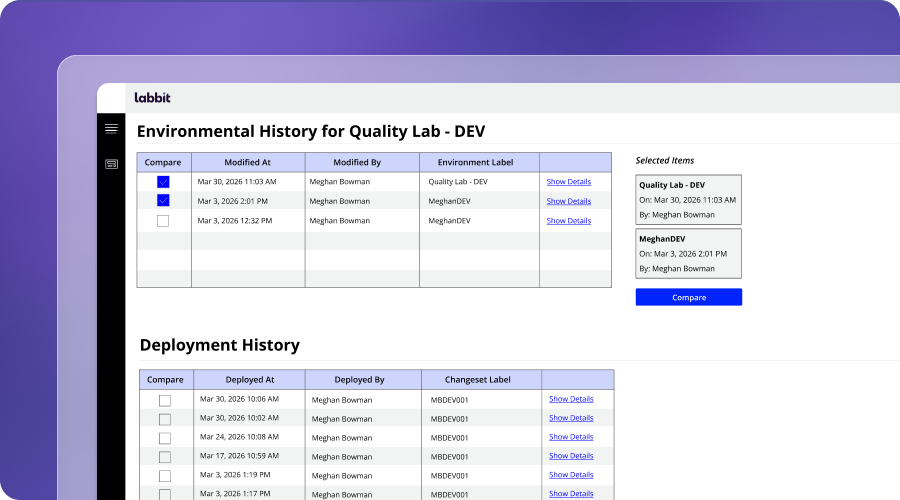
  • Controlled upgrades, focused revalidation — Versioned changesets isolate changes and help target validation where it’s needed.
  • Graph-native data model — Relationships captured natively for connected, analytics-ready data without reconstruction.
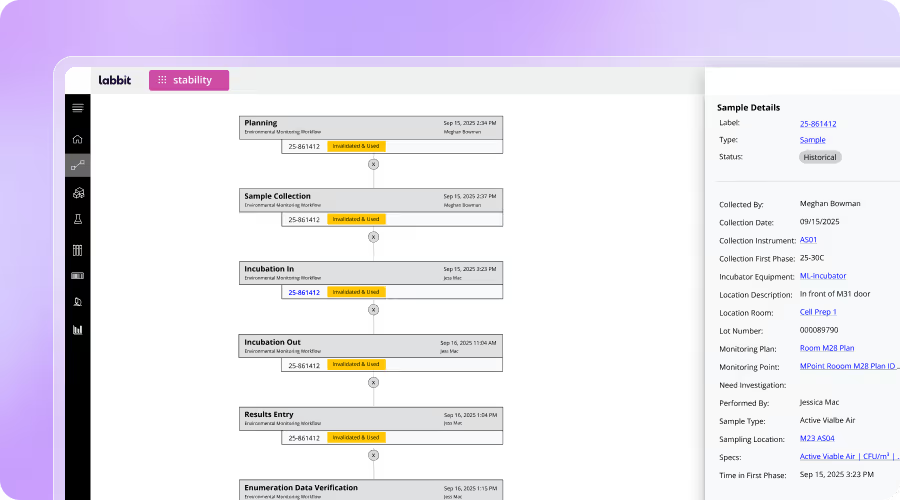
  • Context-rich audit trails — Immutable records preserve the relationships and context behind every action, without custom scripting.
See the side-by-side

Request a demo

See Labbit against your own workflow. We'll reach out within one business day.

Thank you! Your submission has been received!
Oops! Something went wrong while submitting the form.


Trusted by leading labs

No items found.

A SIDE BY SIDE COMPARISON

 Labbit  vs Legacy LIMS

Legacy LIMS platforms can be configured to meet complex lab requirements. What separates them from Labbit is the effort it takes to get there, what it costs to change afterward, and how much of your sample history is available without reconstruction.

Legacy LIMS

Labbit Logo Dark

Implementation & Time-to-Value

Setup relies on proprietary scripting or vendor professional services. Timelines and costs increase with workflow complexity and dependence on specialized technical resources, while changes in requirements can require significant rework.

Uses visual, no-code design tools, configurable workflow templates, and an AI-powered Configuration Assistant to accelerate implementation.

Configuration vs. Customization

Complex workflow changes often move beyond routine configuration into scripting, custom development, or vendor services. As requirements evolve, those changes can add implementation effort and rework.

BPMN-based configuration layer sits above the validated core, allowing lab teams to model and adapt workflows without writing code. Version-controlled configuration supports controlled change and focused revalidation.

Change Management & Upgrade Risk

Configuration and customizations can become tightly coupled to a specific software version, making upgrades more complex. Changes may need to be reconciled, retested, and revalidated with each release.

Changes are captured in versioned changesets above the validated core, making it easier to identify what changed and focus revalidation on affected configurations.

User Experience

Interfaces built module by module can vary in layout and terminology, with screens often cluttered by fields and functions that aren’t relevant to the task at hand.

Labbit presents work through task-specific screens using familiar terminology and intuitive steps. Analysts see only the fields and actions relevant to the work in front of them, without unnecessary information.

Data Architecture & Analytics Readiness

Table-based architectures store data across related records, with connections between samples, workflows, and results typically assembled through joins, queries, or additional logic. As relationships become more complex, reporting, analytics, and AI applications can require more work to build and maintain.

Graph-native architecture stores relationships between samples, workflows, and results directly in the data model. Connected data can be queried and traversed without reconstructing those relationships, supporting reporting, audit traversal, analytics, and AI applications.

Regulatory Compliance

Legacy platforms can meet compliance requirements, but traceability depends on how the system was implemented and configured. A complete sample lineage may require information to be reconstructed across records, with the quality of that traceability shaped by implementation choices.

Labbit captures audit records with the relationships and context preserved in the data model. Steps, decisions, and results are part of a connected, immutable electronic record that can be traced without reconstruction or custom scripting.

Why do labs choose  
Labbit?

Faster implementation timelines

Scripting-based configuration makes a LIMS implementation a development project by nature, making it complex to scope and time-consuming to build. Labbit’s visual workflow tools, configurable templates, and AI-powered Configuration Assistant are designed to reduce implementation effort and accelerate the path from requirements to a working system.

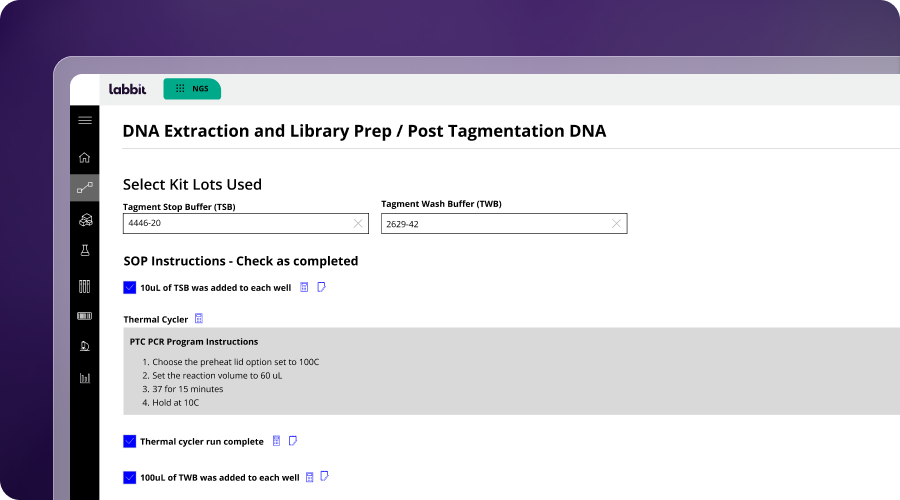
Digital form interface titled DNA Extraction and Library Prep/Post Tagmentation DNA displaying selectable kit lot numbers, SOP checklist with checked steps, and thermal cycler PCR program instructions.

Configuration change enablement

Most LIMS platforms are configurable at implementation. It’s what happens afterward that can create friction. When configuration is tightly coupled to the underlying system, workflow changes or software upgrades can become significant development projects. Labbit’s configuration layer is designed for ongoing change: versioned and isolated from the validated core, with controlled updates that reduce development overhead and support focused revalidation.

Traceability without
reconstruction

When an auditor asks for the full history of a sample, traceability in many systems depends on how data capture and relationships were implemented. If the system wasn’t designed to capture a particular connection, reconstructing that context later can be difficult. In Labbit, relationships are captured natively in the data model, so sample lineage and its surrounding context are part of the record from the start, without requiring reconstruction through custom queries or scripting.

What Our Customers Say

"When we saw how Labbit works, it was clear how thoughtfully they built the system to address the challenges their customers had encountered with other LIMS."

John ten Bosch
VP of Laboratory Operations, BillionToOne

"As our testing business grows, it's important that the systems supporting our laboratories can grow with it. Having a LIMS platform like Labbit that connects workflows with real-time operational data gives our teams clearer visibility into what's happening across the lab, while also providing the robust, modern technical foundation we need to scale our operations into the future."

Keith Gligorich
SVP Global Operations, Veracyte

“Labbit empowered us to transcend the traditional trade-offs between advanced features the commercial side of the business wants and the user experience that our laboratorians require.”

Ronak Kadakia
COO, LinusBio

“That’s what stood out when evaluating Labbit—that this LIMS could finally achieve all of our needs with one solution.”

Tyler Cassens
Senior Product Manager, Helix

FAQ

Frequently Asked Questions

A few of the questions we hear most. If you have others, request a demo, we're easy to talk to.

How long does a Labbit implementation take?
+
-

Timelines depend on workflow complexity and the number of sites involved, but Labbit's approach is built to compress them. Workflows are modeled visually in BPMN and drawn from configurable templates rather than written in a proprietary scripting language, and validation runs against templates instead of starting from scratch. That shifts implementation from a custom development project to a configuration exercise, which is the single largest difference in time-to-value versus a legacy platform.

Can our lab team configure workflows without a developer?
+
-

Yes. Labbit's configuration layer is visual and no-code, built on BPMN, the same notation used to map processes on a whiteboard. Lab staff who understand the SOP can model it directly, including decision points, routing, and the lab's own terminology. An AI-powered configuration assistant accelerates the first draft. Developers are not a prerequisite for routine workflow changes.

How does Labbit handle validation and revalidation when workflows change?
+
-

Every configuration change is bundled into a versioned changeset that sits above the validated core. Because the change is isolated and its scope is explicit, revalidation is limited to what was actually modified rather than the whole system. Software upgrades don't intermingle with your configuration, so they don't trigger a reconciliation exercise across existing customizations.

Is Labbit suitable for regulated lab environments?
+
-

Yes. Labbit is SOC 2 certified and supports compliance with 21 CFR Part 11, ISO 17025, CAP/CLIA, HIPAA, and GDPR. Its graph-based audit trails capture all data, metadata, and relationships natively and immutably, so the complete history of any sample is traversable without reconstruction.

Can Labbit handle high sample volumes and multi-site operations?
+
-

Yes. Labbit is cloud-native and built for throughput, with customers running high-volume production workloads and multi-site operations on a single unified platform. Because the data model is graph-native, performance on investigations and reporting does not degrade as relationships between samples, batches, and results accumulate.

GET STARTED

See how  Labbit  works for labs like yours

Book a 30-minute demo to see visual workflow modeling, real-time execution visibility, and knowledge graph insights in action.

Trusted by

Request a demo

See Labbit against your own workflow. We'll reach out within one business day.