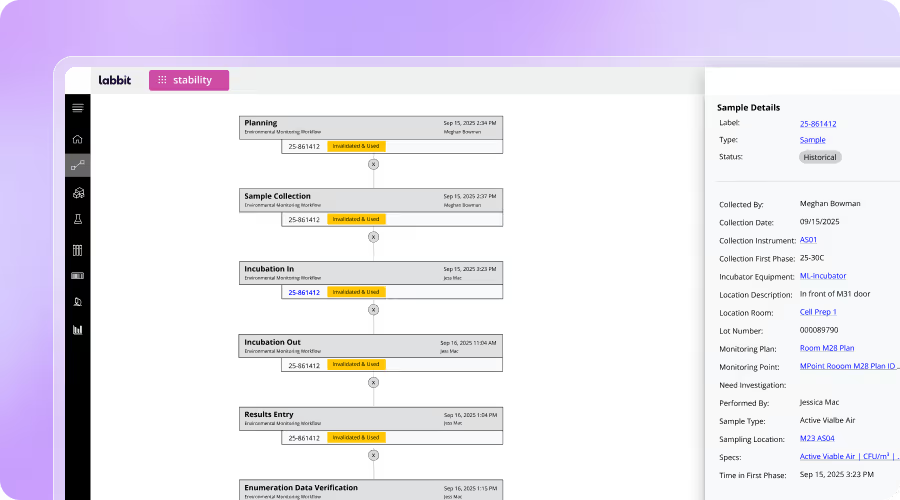
Legacy LIMS platforms can be configured to meet complex lab requirements. What separates them from Labbit is the effort it takes to get there, what it costs to change afterward, and how much of your sample history is available without reconstruction.

Setup runs through proprietary scripting or vendor professional services. Timelines and cost scale with workflow complexity and the availability of skilled technical resources, and much of the work is redone as requirements shift mid-project.
Utilizes visual, no-code design tools, configurable workflow templates, and an AI-powered configuration assistant to accelerate implementation.
The line between configuration and customization is blurry. Most meaningful workflow changes require scripting, so routine adjustments carry the overhead of a software project regardless of their complexity.
The BPMN-based configuration layer sits above the validated core, giving lab teams direct control over workflows without writing code. Configuration stays configuration, not software development.
Configuration is locked to a version, so upgrades frequently conflict with existing customizations. Reconciling what broke, what needs rewriting, and what requires revalidation is a recurring cost with each release.
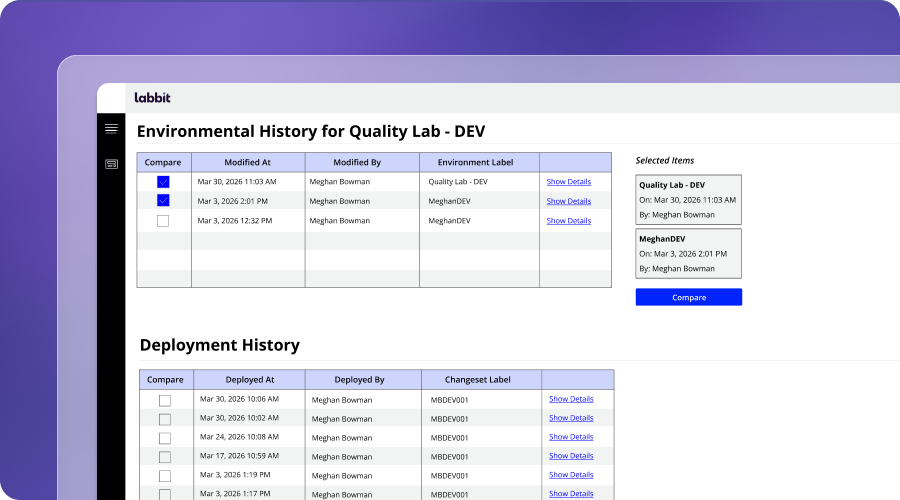
Every change is bundled into a versioned changeset, isolated above the validated core. Revalidation scope is limited to what was actually touched, and upgrades don't disturb what wasn't.
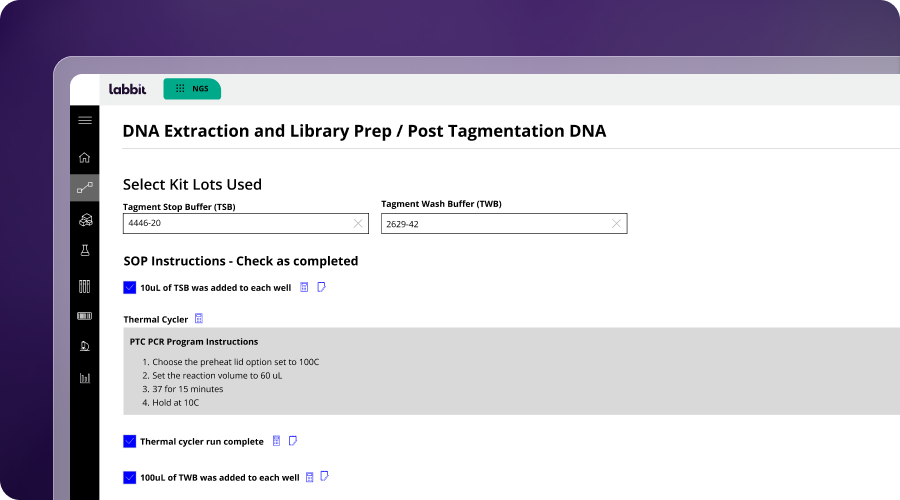
Interfaces built module by module vary in layout and nomenclature. Analysts navigate screens designed for a general lab scenario rather than the task in front of them, which slows training and invites error at the bench.
Tasks in Labbit are supported by screens designed around the specific work being performed, presented in familiar language with steps laid out intuitively for the lab environment. Analysts see only what's relevant to their current step: the right fields, the right actions, nothing more
Table-based architecture stores data in disconnected records. Connections between samples, workflows, and results have to be assembled through queries and custom scripting, making reliable reporting, analytics, and AI tooling more complex to build and maintain.
Graph-native architecture stores relationships between samples, workflows, and results as direct connections in the data model, not as something that has to be assembled through queries. Reporting, audit traversal, and AI integration are fast by design because the data model was built for connected querying, not retrofitted for it.
Legacy platforms can meet compliance requirements, but traceability depends on how the system was scripted during implementation. A complete sample lineage isn't a native output, it's a reconstruction whose quality reflects choices made when the system was built.
Complete audit trails are captured automatically because relationships are native to the data model. Every step, decision, and result is part of a connected, immutable electronic record, immediately traversable without reconstruction or custom scripting.
Scripting-based configuration makes a LIMS implementation a development project by nature, complex to scope and time-consuming to build. Labbit's visual workflow tools, configurable templates, and AI-powered configuration assistant are designed to compress that timeline, making it faster to get from requirements to a working system regardless of who's doing the configuring


Most LIMS platforms are configurable at implementation. It's what happens afterward that creates friction. When configuration lives inside the database without guardrails, any update to a workflow or a new version of the software can become a significant development project. Labbit's configuration layer is designed for change from the outset: versioned, isolated from the validated core, and updatable without the overhead of a full development cycle.
When an auditor asks for the full history of a sample, the answer in most systems depends on what was instrumented during implementation. If a workflow wasn't configured to capture something, it isn't there. In Labbit, traceability isn't a configuration choice, it's a function of the data model. Every connection is recorded automatically, making the complete record of any sample immediately accessible.


"When we saw how Labbit works, it was clear how thoughtfully they built the system to address the challenges their customers had encountered with other LIMS."
.jpeg)
"With a Next-Generation LIMS like Labbit, the high amount of money and effort ultimately wasted when a LIMS solution never gets deployed or adopted may become a problem of the past."

“Labbit empowered us to transcend the traditional trade-offs between advanced features the commercial side of the business wants and the user experience that our laboratorians require.”

“That’s what stood out when evaluating Labbit—that this LIMS could finally achieve all of our needs with one solution.”
A few of the questions we hear most. If you have others, request a demo, we're easy to talk to.
Timelines depend on workflow complexity and the number of sites involved, but Labbit's approach is built to compress them. Workflows are modeled visually in BPMN and drawn from configurable templates rather than written in a proprietary scripting language, and validation runs against templates instead of starting from scratch. That shifts implementation from a custom development project to a configuration exercise, which is the single largest difference in time-to-value versus a legacy platform.
Yes. Labbit's configuration layer is visual and no-code, built on BPMN, the same notation used to map processes on a whiteboard. Lab staff who understand the SOP can model it directly, including decision points, routing, and the lab's own terminology. An AI-powered configuration assistant accelerates the first draft. Developers are not a prerequisite for routine workflow changes.
Every configuration change is bundled into a versioned changeset that sits above the validated core. Because the change is isolated and its scope is explicit, revalidation is limited to what was actually modified rather than the whole system. Software upgrades don't intermingle with your configuration, so they don't trigger a reconciliation exercise across existing customizations.
Yes. Labbit is SOC 2 certified and supports compliance with 21 CFR Part 11, ISO 17025, CAP/CLIA, HIPAA, and GDPR. Its graph-based audit trails capture all data, metadata, and relationships natively and immutably, so the complete history of any sample is traversable without reconstruction.
Yes. Labbit is cloud-native and built for throughput, with customers running high-volume production workloads and multi-site operations on a single unified platform. Because the data model is graph-native, performance on investigations and reporting does not degrade as relationships between samples, batches, and results accumulate.
Book a 30-minute demo to see visual workflow modeling, real-time execution visibility, and knowledge graph insights in action.


See Labbit against your own workflow. We'll reach out within one business day.