Labbit  vs Sapio Sciences

Trying to decide between Labbit and Sapio?

Both are modern platforms, and both will look capable in a demo. The difference is what each was built to do first, and how that shows up once your workflows hit regulated production.
  • Built for execution, not notes — BPMN workflow modeling and enforced SOPs at the bench
  • Graph-native data model — relationships stored as connections, not assembled by query
  • GMP and CGT depth — electronic batch records and chain of custody as native output
  • Configuration your lab owns — versioned changesets isolated above the validated core
See the side-by-side

Request a demo

See Labbit against your own workflow. We'll reach out within one business day.

Thank you! Your submission has been received!
Oops! Something went wrong while submitting the form.


Trusted by leading labs

No items found.

A SIDE BY SIDE COMPARISON

 Labbit  vs Sapio

Sapio is a capable, modern platform with broad coverage across the lab. Where the two systems diverge is in origin. Sapio began with the notebook and built outward; Labbit was built for regulated execution from the first line of code. That difference shows up in how workflows are modeled, how data is related, and what the system produces when an auditor asks.

Sapio

Labbit Logo Dark

Platform Origin & Focus

Sapio began as an electronic lab notebook in 2004 and added LIMS capability later, bringing the pieces together as a modular platform in 2020. The breadth is real, but it is breadth assembled across products rather than built as one.

Labbit was built as a single system for regulated lab execution from the start. Workflow modeling, sample management, and traceability are one platform, not modules brought together after the fact.

Workflow Execution

Workflows are assembled from the platform's configurable modules and screens, which suits processes that fit the structures the platform provides.

Workflows are modeled visually in BPMN, the same notation used to map a process on a whiteboard. Every decision point, route, and step is captured, including your lab's own terminology, and the model that gets drawn is the model that runs at the bench.

Configuration Model

Configuration is handled through the platform's own tooling. How a given change is versioned, and how much has to be revalidated when it ships, depends on how the system was set up.

The configuration layer sits above the validated core. Every change is bundled into a versioned changeset, so revalidation scope is limited to what was actually touched and upgrades don't disturb what wasn't.

Data Architecture

A modular platform surfaces relationships between samples, workflows, and results through its application layer. Reporting and AI tooling work through that layer rather than against the data directly.

Graph-native architecture stores those relationships as direct connections in the data model. Reporting, audit traversal, and AI integration query the data itself, with no intermediary layer deciding what is reachable.

Regulated Manufacturing

Serves regulated environments across research and QC, with the depth of GMP manufacturing execution dependent on configuration.

Electronic batch records that enforce SOPs, chain of custody and chain of identity, environmental monitoring with scheduling and trending, and complete genealogy. Built for GMP execution, not adapted to it.

Scale & Performance

Well suited to research and mid-volume laboratory environments.

Proven at high throughput and across sites. Veracyte unified three laboratories on Labbit, and performance on investigations and reporting does not degrade as relationships accumulate.

Why do labs choose  
Labbit  over Sapio?

Execution-first architecture

A notebook records what happened. An execution system decides what happens next. Labbit models the lab's real process in BPMN, with decision points, routing, and conditional logic that run at the bench rather than describing it afterward. For labs whose workflows split, transform, and branch, that difference determines whether the system reflects the work or the work bends to fit the system.

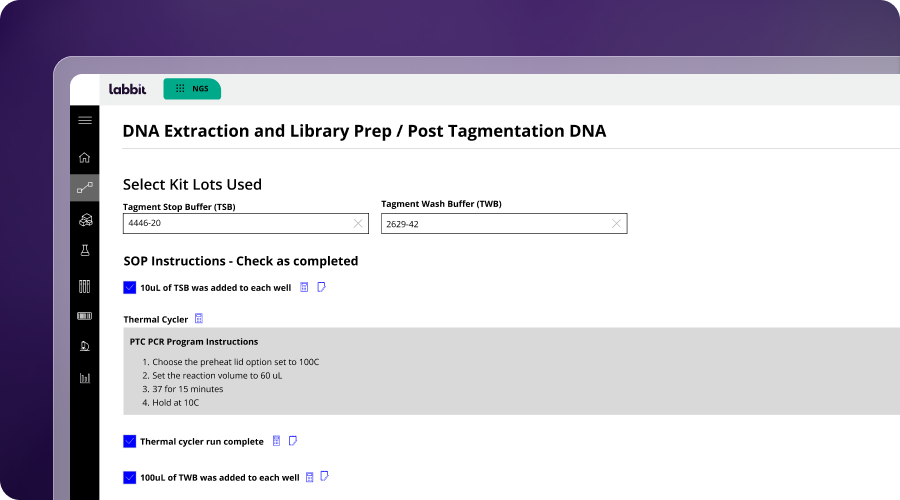
Digital form interface titled DNA Extraction and Library Prep/Post Tagmentation DNA displaying selectable kit lot numbers, SOP checklist with checked steps, and thermal cycler PCR program instructions.

Configuration change enablement

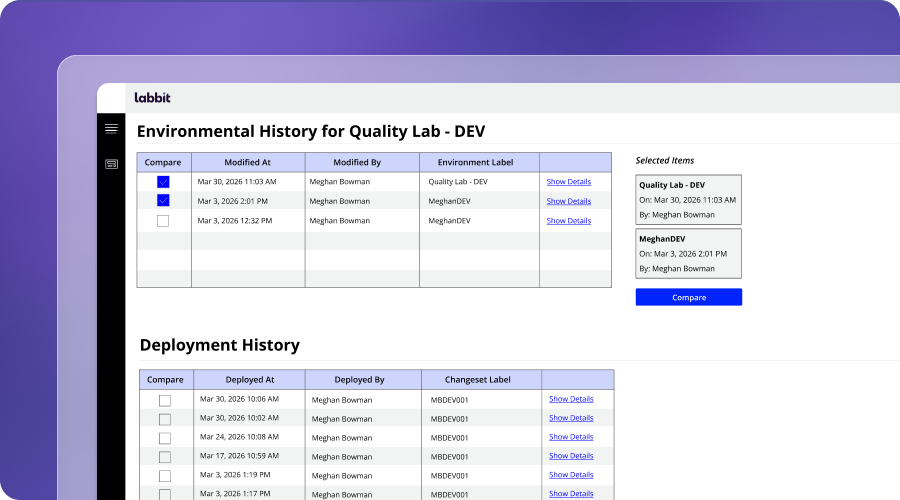
Most modern platforms are configurable at implementation. What separates them is what happens on the fiftieth change, two years in, under a validated system. Labbit's configuration layer is versioned and isolated from the validated core by design, so a workflow update is a scoped changeset rather than a negotiation about how much of the system has to be revalidated.

Traceability without reconstruction

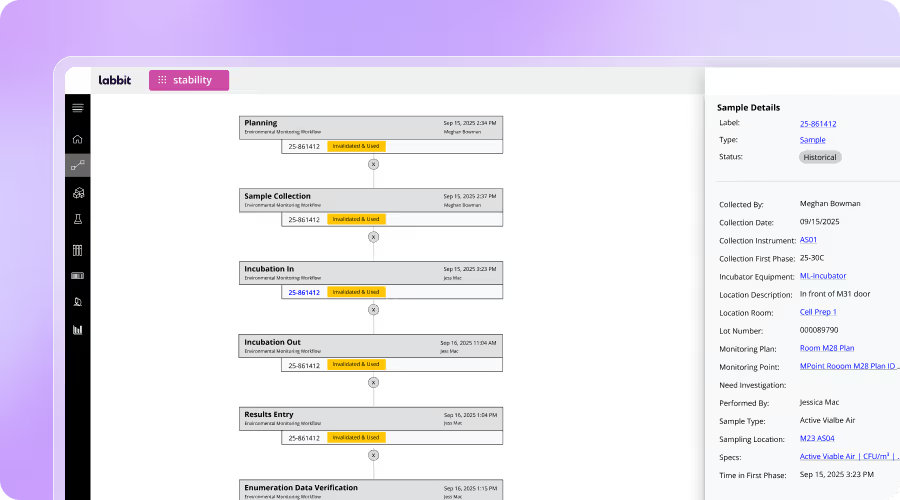
When an auditor asks for the full history of a sample, the answer should already exist. In Labbit it does, because relationships between samples, workflows, and results are native to the data model rather than assembled on request. Every step, decision, and result is part of a connected, immutable record, immediately traversable without custom scripting.

What Our Customers Say

"When we saw how Labbit works, it was clear how thoughtfully they built the system to address the challenges their customers had encountered with other LIMS."

John ten Bosch
VP of Laboratory Operations, BillionToOne

"With a Next-Generation LIMS like Labbit, the high amount of money and effort ultimately wasted when a LIMS solution never gets deployed or adopted may become a problem of the past."

John Conway
Chief Visioneer, 20 / 15 Visioneers

“Labbit empowered us to transcend the traditional trade-offs between advanced features the commercial side of the business wants and the user experience that our laboratorians require.”

Ronak Kadakia
COO, LinusBio

“That’s what stood out when evaluating Labbit—that this LIMS could finally achieve all of our needs with one solution.”

Tyler Cassens
Senior Product Manager, Helix

FAQ

Frequently Asked Questions

A few of the questions we hear most. If you have others, request a demo, we're easy to talk to.

What is the main difference between Labbit and Sapio?
+
-

Origin, and what that origin optimised for. Sapio started as an electronic lab notebook and grew into a modular platform covering ELN, LIMS, and adjacent functions. Labbit was built as a workflow-driven LIMS for regulated execution, where the system has to model a process precisely enough to run it at the bench and produce a complete record of what happened. Both are modern. They are optimised for different centres of gravity.

We need both an ELN and a LIMS. Does that make Sapio the better fit?
+
-

Not automatically. The question worth asking is which of the two functions carries more risk in your environment. If the answer is regulated execution, GMP batch records, chain of custody, high-throughput production, then the execution layer is the thing that should be strongest, and it is the harder of the two to retrofit. Labbit covers sample management, workflow execution, and traceability in one system.

How does Labbit's data model differ?
+
-

Labbit's data model is graph-native. Relationships between samples, workflows, and results are stored as direct connections rather than assembled through queries or surfaced by an application layer. In practice that means investigations, audit traversal, reporting, and AI tooling read the connected data directly, and performance holds as those relationships accumulate.

Can our lab team configure workflows without a developer?
+
-

Yes. Labbit's configuration layer is visual and no-code, built on BPMN, the same notation used to map processes on a whiteboard. Lab staff who understand the SOP can model it directly, including decision points, routing, and the lab's own terminology. An AI-powered configuration assistant accelerates the first draft.

Is Labbit suitable for regulated lab environments?
+
-

Yes. Labbit is SOC 2 certified and supports compliance with 21 CFR Part 11, ISO 17025, CAP/CLIA, HIPAA, and GDPR. Its graph-based audit trails capture all data, metadata, and relationships natively and immutably.‍

GET STARTED

See how  Labbit  works for labs like yours

Book a 30-minute demo to see visual workflow modeling, real-time execution visibility, and knowledge graph insights in action.

Trusted by

Request a demo

See Labbit against your own workflow. We'll reach out within one business day.