QBench is a lighter-weight LIMS well-suited for small to medium-sized labs and more straightforward laboratory operations. Labbit is designed for complex, high-volume environments, with a graph-native data model and workflow-first architecture built to support interconnected data, complex processes, and evolving laboratory operations.

Well suited to smaller labs with stable, straightforward workflows and limited IT resources, where getting running quickly matters more than modeling process complexity
Built for labs whose workflows are complex, regulated, or scaling, where the system has to reflect how the work actually happens and produce a complete record of it.
Schema is organized around a single core entity so the system’s architecture doesn’t always mirror how a lab actually operates. If work is driven by a different unit, that reality must be represented through relationships layered on top of the schema creating friction as volumes and complexity increase.
Graph-native model lets the system's structure reflect the lab's actual operating reality. Samples, tests, batches, and orders exist as equally fundamental entities, so however a lab is organized, the data model represents it directly, and as labs add layers or exceptions, that complexity becomes new relationships, not workarounds.
Workflow, field, and report changes can be made without code, but the underlying data relationships are established at initial configuration. Changing those relationships later often means re-implementing parts of the system rather than adjusting them, so complex workflow changes can require significant rework and revalidation.
Teams can easily make workflow configuration changes in Labbit's Designer without writing any code. Configurations sit above the database and validated core, and any changes are versioned and highlighted to minimize revalidation scope and expedite system updates.
Tracing a sample’s full history in a relational database means joining across tables. Investigations that follow paths outside the system’s original design require reconstructing connections after the fact.
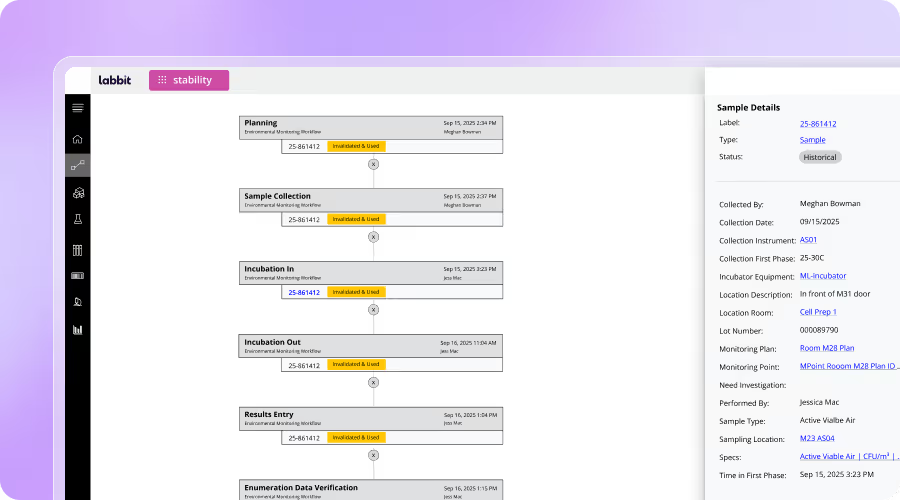
In a graph-native database, relationships between samples, tests, batches, and orders are stored as direct, traversable connections, not reconstructed through joins. Tracing any path through the data is a direct query, keeping labs audit-ready by design.
As schema is anchored around a single core entity, a search spanning samples, tests, batches, and orders requires joins across related tables. As volumes grow, joins multiply, slowing search and page loading.
Graph-native model stores relationships directly, so results come from traversing existing connections rather than reconstructing them through joins. Performance stays consistent as volumes grow since relationships are read, not recomputed.
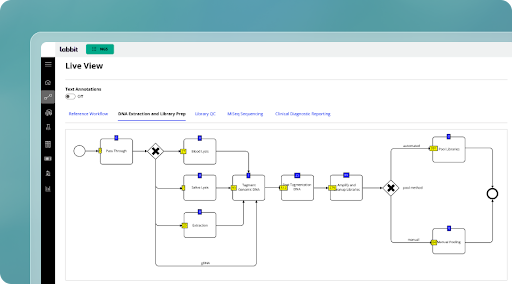
Rather than forcing your lab to adapt to the software's structure, Labbit adapts to you. Using BPMN, your team visually diagrams how your lab actually runs, in your own terminology, and that reality is ingested directly into the system. Labbit's flexible data model makes this possible: instead of forcing your process through a predefined structure, it takes the shape of your process instead.

.png)
Labs don’t stay static. New assays, regulations, and instruments impose workflow changes over time. Labbit was built for that reality allowing for changes to be made easily and safely, without custom development or large revalidation effort. The result is a system that keeps pace with wherever your lab needs to go next.
Rebuilding relationships after the fact slows investigations and audits down and carries risk of gaps or errors. In Labbit's graph, relationships are captured naturally as they happen, stored as traversable connections in complete, immutable records. Tracing any path through your data means following existing connections, not reconstructing them.

.png)
As numbers of orders, samples, and employees climb, systems that assemble results through table joins can begin to slow down. Search lags, pages take longer to load, and the system feels heavier the more you use it. Because Labbit reads relationships directly instead of recomputing them, performance holds steady as your lab scales, so growth doesn't come with a performance tax.

"When we saw how Labbit works, it was clear how thoughtfully they built the system to address the challenges their customers had encountered with other LIMS."
.jpeg)
"With a Next-Generation LIMS like Labbit, the high amount of money and effort ultimately wasted when a LIMS solution never gets deployed or adopted may become a problem of the past."

“Labbit empowered us to transcend the traditional trade-offs between advanced features the commercial side of the business wants and the user experience that our laboratorians require.”

“That’s what stood out when evaluating Labbit—that this LIMS could finally achieve all of our needs with one solution.”
A few of the questions we hear most. If you have others, request a demo, we're easy to talk to.
Usually at a specific event rather than gradually. A new assay the current system can't model. Moving from paper to digital across manufacturing. Scaling NGS or batch volume. An FDA audit finding or a CAP observation. Bringing multiple labs under one system after an acquisition. Hiring the first IT or informatics leader. If none of those has happened, a lightweight system may still be the right answer.
Most LIMS assume a sample moves forward through a fixed sequence of steps. Complex workflows don't work that way: entities transform, split, pool, and change state over the course of execution. When the system can't model that, labs end up working around it with spreadsheets, manual steps, and tribal knowledge, which is where errors and audit gaps come from. Labbit allows any entity to move through a workflow and transform along the way.
If your workflows are simple and stable, your lab operates from one site, and you have no GxP obligations, then probably yes, and we'll tell you that on the call. Labbit earns its keep where processes are complex, regulated, or changing. The labs that get the most from it are the ones where a workflow change today would otherwise mean a development ticket and a revalidation exercise.
Workflows are rebuilt visually in BPMN rather than scripted, and validation runs against templates rather than starting from scratch, which is what compresses the timeline. Historical sample data and relationships are carried into the graph model. Our services team runs the migration alongside your lab rather than handing over a specification.
Yes. Labbit is SOC 2 certified and supports compliance with 21 CFR Part 11, ISO 17025, CAP/CLIA, HIPAA, and GDPR. Its graph-based audit trails capture all data, metadata, and relationships natively and immutably.
Book a 30-minute demo to see visual workflow modeling, real-time execution visibility, and knowledge graph insights in action.


See Labbit against your own workflow. We'll reach out within one business day.