How architectural decisions shape a lab's ability to iterate workflows, maintain compliance, query data, and lay the groundwork for advanced analytics.

Built to serve many lab environments, LabVantage's architecture bundles extensive pre-built functionality, meaning customization creates dependencies that compound over time.
Labbit's configuration layer sits above the application, so teams build only what their workflows require. No inherited functionality, no technical debt accumulating below the surface.
Changes are managed across separate systems and applied manually via installation scripts. There is no single source of truth for what changed, making iteration slow and validation status difficult to maintain.
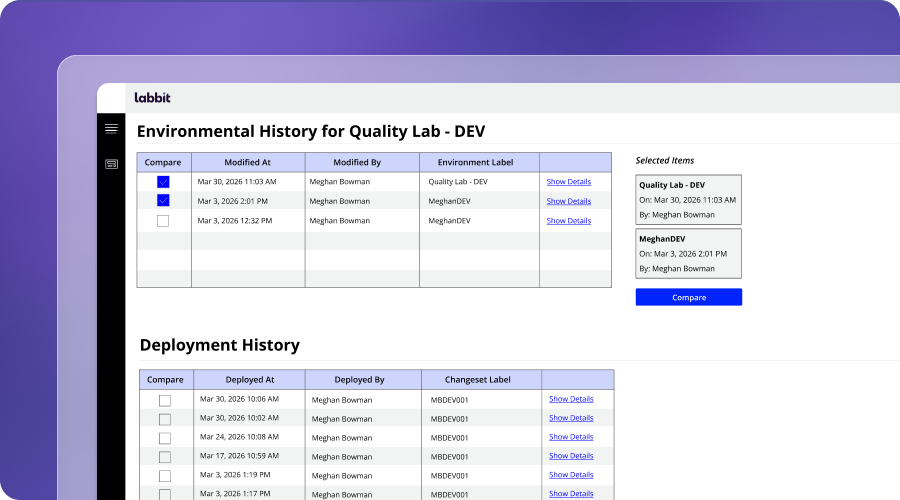
Every update is bundled into a single versioned changeset. Revalidation scope is limited to only what was touched, nothing more.
Relational architecture stores data in disconnected tables. Querying across samples, workflows, and results requires complex joins, making reporting and data retrieval a slower process.
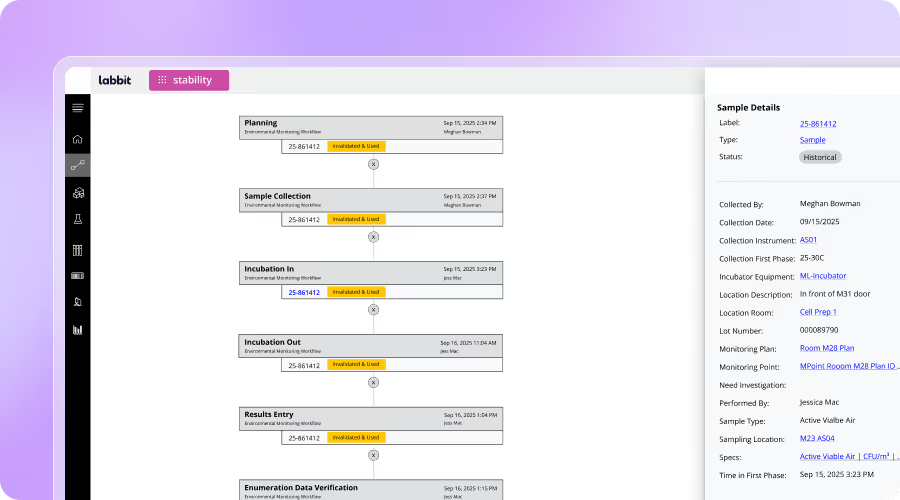
Graph-native architecture captures relationships between samples, workflows, and results as first-class data, making queries, reporting, and audit traversal fast by design.
The relational architecture requires custom scripting to reconstruct a sample's complete lineage. Traceability is an afterthought, not a native capability.
Because relationships are native to the data model, complete audit trails are captured automatically and instantly traversable. No reconstruction required.
Relational architecture stores relationships as implicit joins, requiring a purpose-built abstraction layer for AI, limiting flexibility and tying teams to specific tooling.
Graph-native architecture makes relationships explicit and traversable by design, giving LLMs the connected context they need without an intermediary layer.
Labbit is designed to give laboratory teams the flexibility to configure and extend the platform without compromising the validated core. Configuration sits above the application layer by design, meaning every change is tracked, versioned, and isolated from the underlying system. Teams can evolve workflows, add custom logic, and adapt to new processes with confidence that revalidation scope stays limited to only what changed. This separation isn't just an architectural detail. In regulated environments, knowing exactly what changed, and what didn't, is the difference between a targeted revalidation and a system-wide one.


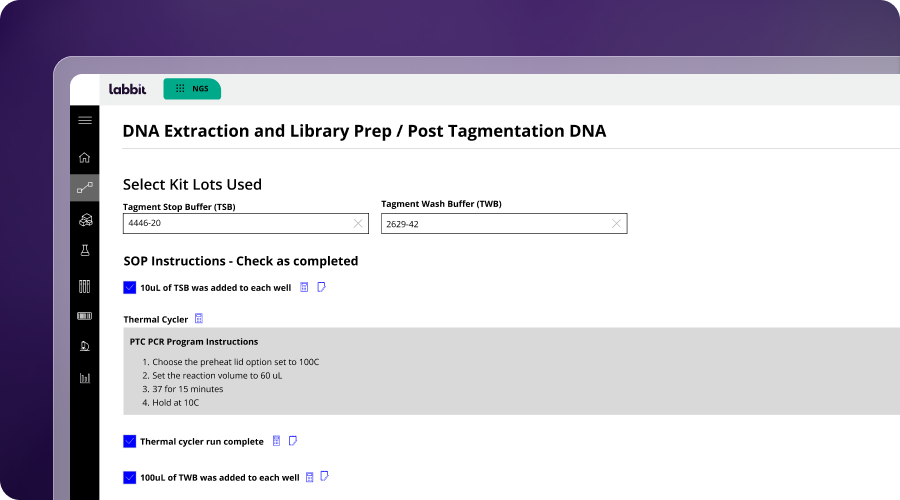
Labbit builds every screen around the specific task being performed. Analysts see only what is relevant to their current step: the right fields, the right actions, nothing more. There is no clutter to navigate around, no irrelevant options to ignore, and no need to be trained on what doesn't apply. The result is an experience that feels intuitive from day one. Fewer errors, shorter training cycles, and a UI that adapts to the complexity of the work rather than asking analysts to adapt to the complexity of the system.
Labbit captures every sample, process, result, and decision as part of a connected, immutable record. Rather than reconstructing traceability through custom scripting and manual data analysis, the platform preserves the full context of laboratory operations as work is performed. Because data, metadata, workflows, and relationships are natively connected, complete traceability is always available and instantly accessible. The result is faster investigations, audit-ready evidence, and a structured, AI-ready foundation for analytics, automation, and intelligent decision-making.


"When we saw how Labbit works, it was clear how thoughtfully they built the system to address the challenges their customers had encountered with other LIMS."
.jpeg)
"With a Next-Generation LIMS like Labbit, the high amount of money and effort ultimately wasted when a LIMS solution never gets deployed or adopted may become a problem of the past."

“Labbit empowered us to transcend the traditional trade-offs between advanced features the commercial side of the business wants and the user experience that our laboratorians require.”

“That’s what stood out when evaluating Labbit—that this LIMS could finally achieve all of our needs with one solution.”
A few of the questions we hear most. If you have others, request a demo, we're easy to talk to.
Labbit is a modern, workflow-driven LIMS built for complex, evolving lab operations. LabVantage is a mature enterprise platform with broad functionality and a long track record in laboratory environments. Where the two differ most is in how they handle change: Labbit's BPMN-based configuration layer sits above the validated core, giving teams a clean, traceable path to adapt workflows over time, keeping revalidation scope contained and upgrades predictable.
LabVantage supports multi-step workflows, but its approach is constrained by an underlying data hierarchy. Samples have tasks, tasks have results, and each level has statuses that flow upward through the chain. Workflows are built by stringing together standard pages within that fixed structure. For many lab processes this works well, but for complex workflows like NGS where entities need to transform, split, or change state over the course of execution, the model can become a poor fit for what is actually happening at the bench. Labbit allows any entity to move through a workflow and to transform along the way, meaning the system can model the real complexity of lab processes rather than asking labs to adapt their processes to fit the system.
In a regulated lab audit, the most common requirement is demonstrating the complete history of a specific sample: every step, every decision, every result, from receipt to release. Labbit captures this natively. Because relationships between samples, workflows, and results are built into the data model, the full audit story of any individual sample is immediately accessible and traversable without reconstruction. LabVantage stores audit data in a consolidated way that makes system-wide querying straightforward, but surfacing the complete context for a specific sample or workflow run requires additional querying to assemble the full picture.
Labbit's graph-based data model natively captures relationships between samples, workflows, and results, making data inherently FAIR (findable, accessible, interoperable, and reusable) and giving LLMs the connected context they need to power meaningful analysis without requiring a separate abstraction layer. LabVantage approaches this through its application layer, which maintains the relationships between data points and can support AI tooling built on top of it. The difference is that in Labbit, those relationships are native to the data itself, making querying, reporting, and AI-driven insights available directly from the data rather than through an intermediary layer that constrains what's possible.
Yes. Labbit is SOC 2 certified and supports compliance with 21 CFR Part 11, ISO 17025, CAP/CLIA, HIPAA, and GDPR. Its graph-based audit trails capture all data, metadata, and relationships natively and immutably.
Book a 30-minute demo to see visual workflow modeling, real-time execution visibility, and knowledge graph insights in action.


See Labbit against your own workflow. We'll reach out within one business day.