Analytical qc lab informatics

The Analytical QC LIMS for Trusted, Defensible Results

Labbit's knowledge graph-native LIMS connects every result to its complete context—from method and instrument to analyst and supporting data—while enforcing the workflows that ensure testing is performed consistently.

Trusted by

Vercyte Logo
Linus Bio Logo
Helix Logo
Billion To One Logo
Vercyte Logo
Linus Bio Logo
Helix Logo
Billion To One Logo
Vercyte Logo
Linus Bio Logo
Helix Logo
Billion To One Logo
Vercyte Logo
Linus Bio Logo
Helix Logo
Billion To One Logo

Why Analytical QC Needs a LIMS Built on Connected Data

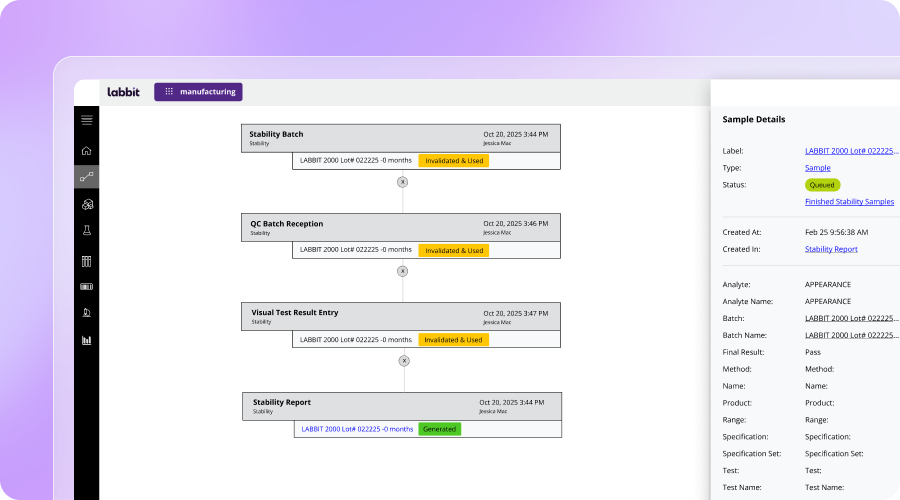
Analytical QC labs are responsible for producing results that can be confidently trusted to support product quality, customer commitments, and business decisions. That requires more than simply recording analytical data—it requires understanding how every result was generated, what influenced it, and whether every step followed the approved process. Labbit's graph-native architecture connects methods, samples, instruments, analysts, workflows, and results as part of the data itself, giving teams immediate access to the complete, defensible story behind every result.

Key Benefits for Analytical QC

Data

Complete Traceability

Automated review and release logic moves a batch from testing to release without someone manually chasing down every required signature or outstanding result.

instruments

Automated Data Capture

Integrate with analytical instruments across your lab to automatically capture data, reducing manual transcription and preserving data accuracy from instrument output through final result.

Review

Improved Review Efficiency

Give analysts and reviewers immediate access to the information needed to evaluate results, with review tasks managed directly in Labbit rather than scattered across email inboxes. Clear workflows ensure nothing is missed or delayed, enabling faster, more confident decisions.

traceability

Faster OOS/OOT Investigations

Out-of-specification and out-of-trend results stay connected to the context investigators need, cutting the time spent reconstructing records across disconnected systems.

reporting

Faster Certificate Generation

Generate CoAs directly from approved results, shortening the time between final result approval and customer-ready documentation while removing the risk of manual transcription errors.

change

Controlled Change. Focused Revalidation

Version method and workflow configurations with complete visibility into what changed, helping teams focus revalidation efforts only on impacted areas.

Support for Core Analytical QC Functions

SPECIFICATION & METHOD MANAGEMENT

Specs & Methods, Always Current

Methods, specifications, and testing requirements are maintained in a single, controlled system, so every test runs against the current, approved version — not an outdated copy from a shared drive or forgotten update. Every change is versioned automatically, giving your team a clear, audit-ready record without separate documentation to maintain.

test execution & data capture

Configured to Reflect & Preserve Your Lab's Reality

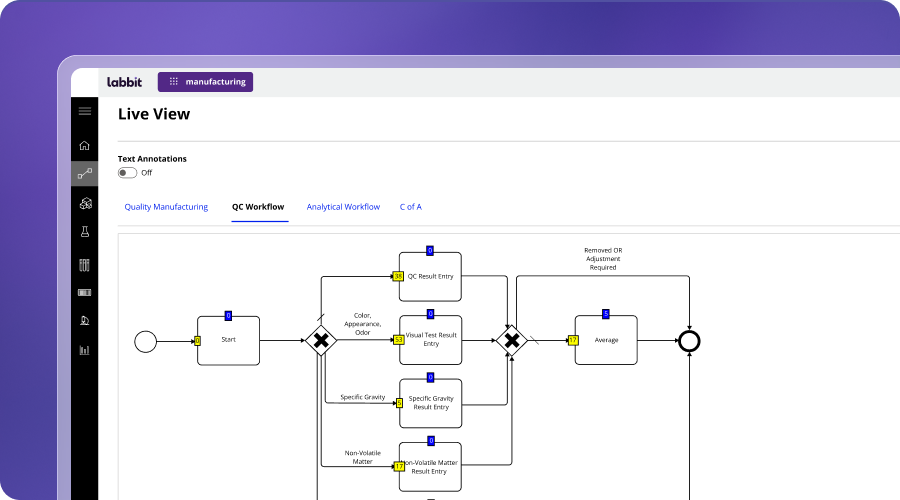
Labbit models your analytical workflows exactly as they operate, orchestrating work between testing, review, approval, and investigation while ensuring every step follows your approved SOPs. As work progresses, the relationships between results, methods, instruments, analysts, and supporting data are preserved automatically, creating a complete record of how every result was produced.

Results review & approval

Accelerate Review with Complete Context

Because every result remains connected to its analytical context, reviewers can evaluate results with everything they need already in one place. Reporting is gated until results have been approved by the appropriate roles, according to your defined process. Anything flagged as out of specification or trend is forwarded directly to investigation.

OOS/OOT INVESTIGATION & RESOLUTION

Root Cause, Without Reconstruction

Connect out-of-specification and out-of-trend results to the methods, instruments, materials, and historical data behind them. Investigations begin with the full context needed to identify potential causes, reducing the effort required to gather records across disconnected systems.

Explore Key Capabilities for Analytical QC Labs

Eyebrow text

Master Data & Spec Governance

Maintain controlled methods, specifications, materials, and other critical data that drive analytical testing workflows..

Eyebrow text

Method & Workflow Configuration

Configure analytical processes and SOP-driven workflows without custom development, enabling teams to adapt as requirements evolve.

Eyebrow text

Instrument Management

Track instrument history, calibration, maintenance, and usage information to support reliable testing and investigations.

Eyebrow text

Review Workflows & eSignatures

Configure role-based approval workflows with electronic signatures, ensuring results are reviewed, approved, and released according to defined procedures.

Eyebrow text

OOS/OOT Investigation

Navigate OOS and OOT results through their connected analytical context, including methods, instruments, materials, and historical data, to accelerate root-cause investigations.

Eyebrow text

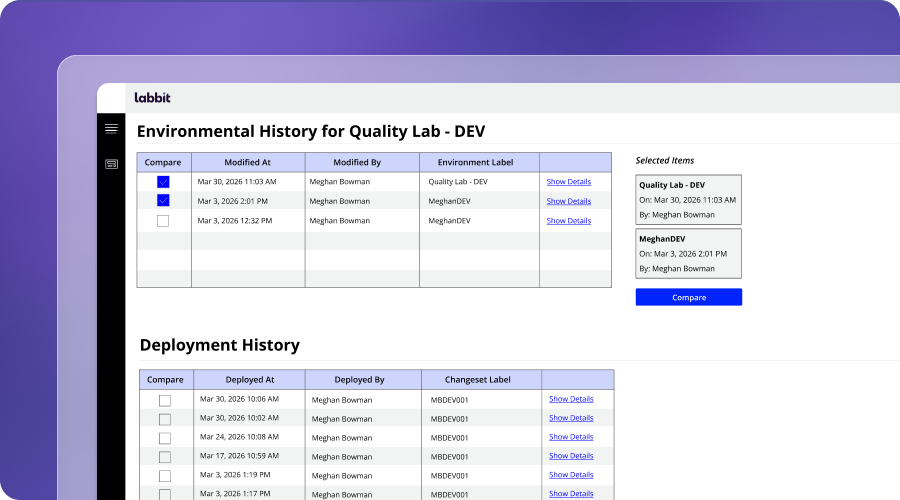
Configuration Change Histories

Track every change to methods, workflows, and system configurations with complete version history, making it easier to understand impacts, support validation activities, and demonstrate controlled change during audits.

Data Security & Control

Analytical QC data drives product quality decisions, customer confidence, and regulatory compliance. Labbit is delivered as a secure cloud platform with isolated customer environments, role-based access control, electronic signatures, immutable audit trails, and configurable security policies that help protect your laboratory data while supporting ISO, FDA, and customer quality requirements. Your data remains secure, controlled, and entirely under your ownership.

Abstract flowing waves in shades of purple and violet creating a smooth, dynamic texture.

Getting started

See how Labbit works for Analytical QC labs like yours

Book a 30-minute demo to see visual workflow modeling, real-time execution visibility, and knowledge graph insights in action. We'll show you how Labbit adapts to your specific workflows.

Frequently Asked Questions

How does Labbit support analytical QC?

A LIMS (Laboratory Information Management System) is the software platform that manages a lab's samples, data, and workflows. Labbit is a LIMS built to support the specific demands of analytical QC — spec management, results review, and OOS/OOT investigation — with the traceability and audit-readiness these labs require.

Can Labbit be configured to match our SOPs?

Yes. Labbit's workflows are configured to reflect your SOPs directly, rather than forcing your lab into a fixed template.

How does Labbit support audit readiness in a QC lab?

Every record is attributed to a user and timestamped at creation, with data captured immutably, so audit trails don't require manual reconstruction.

How does Labbit support ALCOA+ data integrity requirements?

Every record captured in Labbit is attributed to a specific user and timestamped at the moment of creation, with no ability to alter a result without the change being visible in the audit trail. Because upstream, downstream, and release data all stay connected as native relationships, ALCOA+ compliance holds across the full batch record, not just within each individual system.