GMP BIOmanufacturing lab informatics

Built for the Complexity of GMP Biomanufacturing

Manage evolving processes, complex workflows, and critical traceability requirements with a graph-native LIMS built for connected, compliant, and adaptable GMP operations.

Trusted by

Vercyte Logo
Linus Bio Logo
Helix Logo
Billion To One Logo
Vercyte Logo
Linus Bio Logo
Helix Logo
Billion To One Logo
Vercyte Logo
Linus Bio Logo
Helix Logo
Billion To One Logo
Vercyte Logo
Linus Bio Logo
Helix Logo
Billion To One Logo

Key Benefits for GMP Biomanufacturing

release

Accelerated Batch Release

Automated review and release logic moves a batch from testing to release without someone manually chasing down every required signature or outstanding result.

Compliance

Audit-Ready by Default

Every action, from sample login to eSignature, is captured natively as part of the batch’s record, so responding to an inspection or audit request doesn’t require days of special preparation.

CHANGE CONTROL

Flexibility Without the Validation Tax

SOP and workflow changes happen in a configuration layer separated from the validated core, keeping revalidation scoped to what actually changed rather than the whole system.

traceability

Unbroken Chain of Custody & Identity

Starting material, batch, and final product stay connected as native relationships in the data, so identity and custody can be traced end to end rather than reassembled across records, relational tables, or separate systems.

Quality

Quick Deviation & CAPA Resolution

When an investigation is needed, the batch's full upstream and downstream history, materials, equipment, and prior results is available instantly rather than requiring records to be pulled from separate systems and reassembled by hand.

Visibility

Complete Batch Context

Upstream data, downstream processing, fill/finish, and release testing live in the same platform, so nothing has to be reconciled across a separate LIMS, MES, and paper record just to see the full picture of a batch.

Support for Each Stage of GMP Biomanufacturing

Upstream processing

Keep in-process testing connected to manufacturing

Upstream manufacturing depends on laboratory testing to document process performance and support manufacturing decisions. Labbit manages in-process samples from collection through approved results, ensuring every sample follows the appropriate analytical workflow while maintaining complete traceability to the manufacturing batch. 

Every sample, test result, instrument, operator, collection timepoint, and production vessel remains connected as part of a single record. Instead of reconstructing process history across multiple records or disconnected systems, quality and manufacturing teams can immediately navigate the complete context behind every in-process result.

downstream processing

Ensure every purification step follows SOPs

Downstream processing follows strict SOPs where each analytical step must occur in the correct sequence before manufacturing can continue. Labbit is configured around these procedures, ensuring required testing, approvals, and quality checks are completed before the next stage begins. 

As testing progresses, every analytical result remains connected to the associated purification step, manufacturing batch, equipment, and supporting documentation, creating a complete history that simplifies investigations, process review, and regulatory inspections.


FILL & Finish support

Enforce every critical quality checkpoint

Fill and finish operates under the strictest procedural and documentation requirements in GMP biomanufacturing. Labbit embeds required laboratory activities directly into workflows, ensuring critical steps—including sterility testing, quality review, approvals, and eSignatures—cannot be bypassed or completed out of sequence.

Every action automatically contributes to an immutable electronic batch record, creating a complete, audit-ready history that simplifies batch review, investigations, and regulatory inspections.
CHAIN of identity & chain of custody

Preserve complete manufacturing context

Maintaining confidence in product identity and custody requires more than recording individual events—it requires preserving the relationships between them. Labbit connects starting materials, manufacturing batches, laboratory testing, operators, equipment, deviations, and final product as one continuous history throughout manufacturing. 

When quality teams need to investigate an issue or demonstrate traceability, the complete manufacturing story is already connected.

batch review & release

Know that every requirement has been satisfied

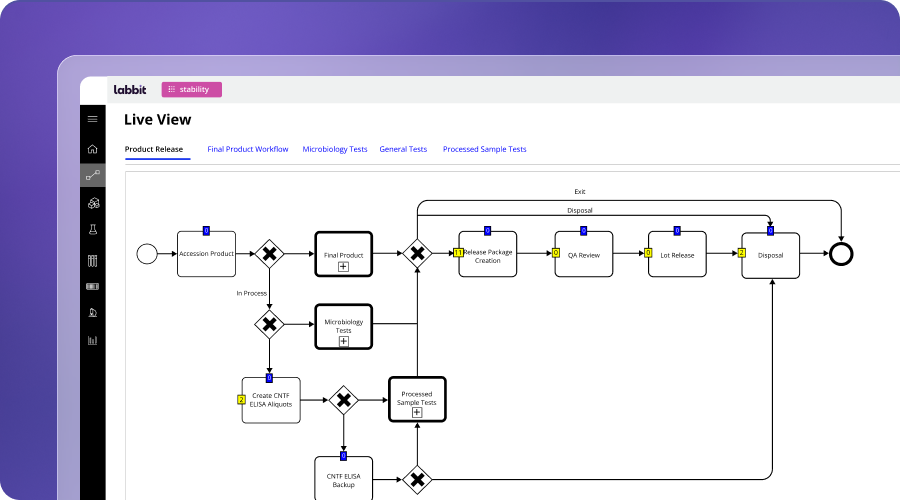
Product release in GMP biomanufacturing depends on complete confidence that every required laboratory activity has been performed, reviewed, and approved. Labbit continuously tracks testing status, pending results, approvals, and release readiness, giving quality teams complete visibility into every batch. 

Configurable workflow logic ensures batches cannot advance until required testing is complete and review criteria have been met, helping accelerate release while maintaining strict compliance.

Key Capabilities for GMP Biomanufacturing

Eyebrow text

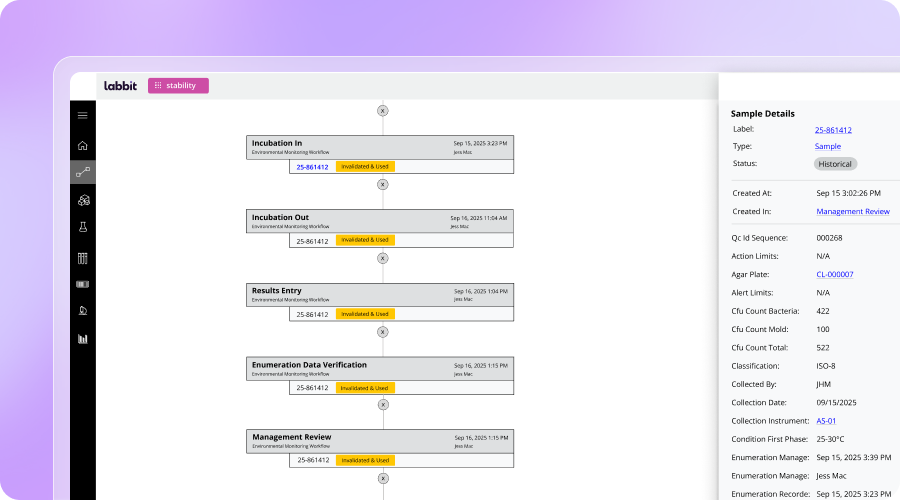
Environmental Monitoring

Connect cleanroom monitoring data, excursions, investigations, and quality workflows to maintain control over critical manufacturing environments. Ensure environmental events are linked to the relevant batches, samples, and quality records for faster assessment and response.

Eyebrow text

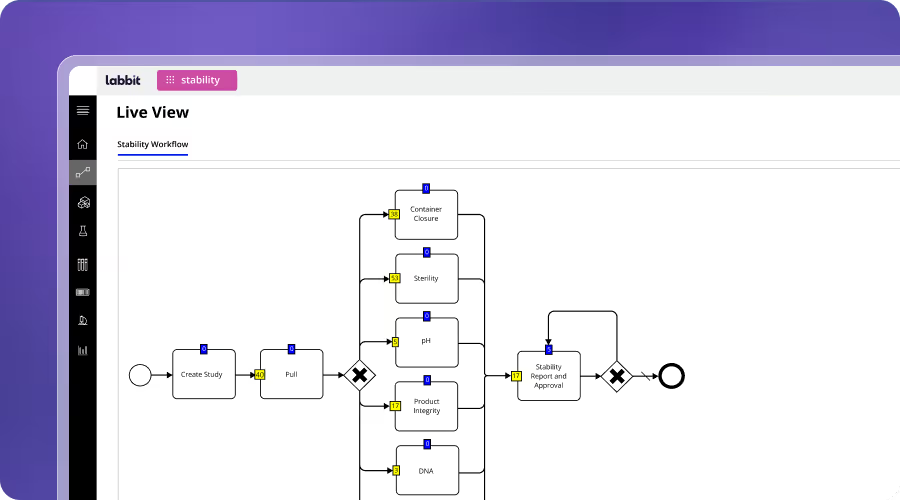
Manage stability studies with connected sample tracking, testing schedules, results, and trending data across the product lifecycle. Maintain visibility into study requirements, timepoints, and results without relying on disconnected spreadsheets or manual tracking.

Eyebrow text

Deviation & CAPA Management

Streamline investigations by connecting deviations and corrective actions to the impacted batches, samples, processes, equipment, and quality events. Give quality teams the full context needed to identify root causes and drive effective resolution.

Eyebrow text

Electronic Batch Records

Generate electronic batch records through configured workflows that capture testing activities, approvals, eSignatures, and release criteria as work is performed. Maintain a complete, traceable record of each batch from manufacturing through final release.

Eyebrow text

Equipment & Instrument Tracking

Maintain a complete history of instruments and equipment, including usage, calibration, maintenance, and associated laboratory activities. Connect equipment data directly to testing workflows to support reliable results and inspection readiness.

Eyebrow text

Role-Based Security

Control access with configurable permissions that align user actions with their responsibilities across QC, QA, MSAT, and manufacturing teams. Ensure critical data and workflows remain secure while supporting compliant collaboration across the organization.

Security & Control for Regulated IT

GMP manufacturing requires confidence that critical data remains secure, controlled, and inspection-ready. Labbit is delivered as a secure cloud platform with isolated customer environments, comprehensive audit trails, role-based permissions, electronic signatures, and configurable validation support designed for regulated laboratories.

Your data remains secure, isolated, and entirely under your control.

Abstract flowing waves in shades of purple and violet creating a smooth, dynamic texture.

Getting started

See how Labbit works for GMP biomanufacturing labs like yours

Book a 30-minute demo to see visual workflow modeling, real-time execution visibility, and knowledge graph insights in action. We'll show you how Labbit adapts to your specific workflows.

Frequently Asked Questions

How does Labbit support GMP biomanufacturing workflows?

Labbit is a graph-native LIMS built to enforce GMP requirements directly in the workflow, connecting upstream culture data, downstream purification steps, fill/finish checkpoints, and release testing in one platform, with SOP compliance and data traceability built in at each stage rather than handled as a manual, after-the-fact process.

Labbit's graph-native structure stores who handled a sample and when (custody), and which specific starting material became which specific final product (identity), as native, connected relationships in the data. Both chains can be traced end to end directly, rather than reconstructed from records scattered across separate systems, which matters most in cell and gene therapy, where a patient's own cells are the starting material.

How does Labbit support MSAT teams?

Because upstream data stays connected to its specific cell line, culture vessel, and batch as it's captured, MSAT teams can trend that data across runs to catch process variation early, and rely on the same configuration layer used for SOP enforcement when transferring a process between sites or scales.

Yes. Labbit generates the electronic batch record as work happens, through configured workflow steps, and that same record tracks which required tests are still outstanding for a batch, including slower assays, which is what release logic checks against before a batch can be released.

How does Labbit support ALCOA+ data integrity requirements?

Every record captured in Labbit is attributed to a specific user and timestamped at the moment of creation, with no ability to alter a result without the change being visible in the audit trail. Because upstream, downstream, and release data all stay connected as native relationships, ALCOA+ compliance holds across the full batch record, not just within each individual system.