
Many regulated labs have GxP-validated LIMS in place, but still rely on paper forms, spreadsheets, PDFs, and email to run a significant portion of day-to-day laboratory operations. Often, teams think about compliance primarily in the context of sample management. But the scope is much broader. Auditors do not just look at how labs log samples and record results in their LIMS. They also scrutinize how teams calibrate equipment, validate methods, investigate deviations, approve procedural changes, and trace reagents end to end. That scrutiny is also showing up more directly in FDA observations: 21 CFR 211.68(b) citations rose roughly 55% from 2022 to 2025.1
As regulatory scrutiny continues to intensify, the gap between what lives inside a GxP controlled environment–and what doesn't–is getting harder to ignore.
What Makes A Process “Controlled” Under GxP?
Before diving into what it takes to run a truly compliant lab, it is important to level-set on what GxP actually means. GxP compliance is more than just system validation. True GxP requires controlled processes.
At a high level, these controlled processes have several defining characteristics.
- Documented: SOPs, protocols, and work instructions are embedded into the system, governing how work is performed
- Validated: the process consistently meets requirements
- Traceable: a clear audit trail links inputs, activities, and outputs
- Deviation-managed: issues are documented, investigated, and resolved with appropriate corrective action
- Access-controlled: only authorized, trained personnel can perform the work, with required review and approval workflows, including electronic signatures where mandated
While the framework is straightforward on paper, applying it consistently across the full range of laboratory workflows is tedious.
But keeping certain workflows outside of a controlled system brings real risk. For one, it’s difficult to demonstrate compliance with requirements and frameworks such as GAMP 5, 21 CFR Part 11, GLP, GMP, ISO 17025, CLIA, and CAP. And when an auditor comes knocking, teams are scrambling to find paper forms, search shared drives for certificates, and piece together records from disconnected systems.
It’s no surprise that audits frequently target areas like deviation handling, equipment records, and change control. These are exactly the areas that labs most often manage outside of controlled environments.
To help solve this compliance challenge, lab teams should bring these auxiliary workflows into their validated LIMS and manage them as controlled processes. Doing so has both regulatory and operational benefits:
- Compliance benefits: controlled workflows provide built-in audit trails, logged approvals, and full traceability, helping labs abide by numerous regulations.
- Efficiency gains: controlled workflows eliminate duplicate data entry across LIMS, QMS, and spreadsheets. With everything centralized and linked, audit prep is no longer a fire drill. And if something does go wrong, investigators can move quickly to resolve issues.
- Scalability: as labs grow, add sites, or expand test menus, the burden of maintaining consistent paper-based workflows multiplies. Standardized electronic workflows solve this, since teams can configure once and deploy everywhere, providing consistency across teams and locations.
- Data integrity: electronic workflows simplify and streamline data entry, providing built-in ALCOA compliance (attributable, legible, contemporaneous, original, accurate).
How To Bring GxP Compliance To Every Part Of Your Lab
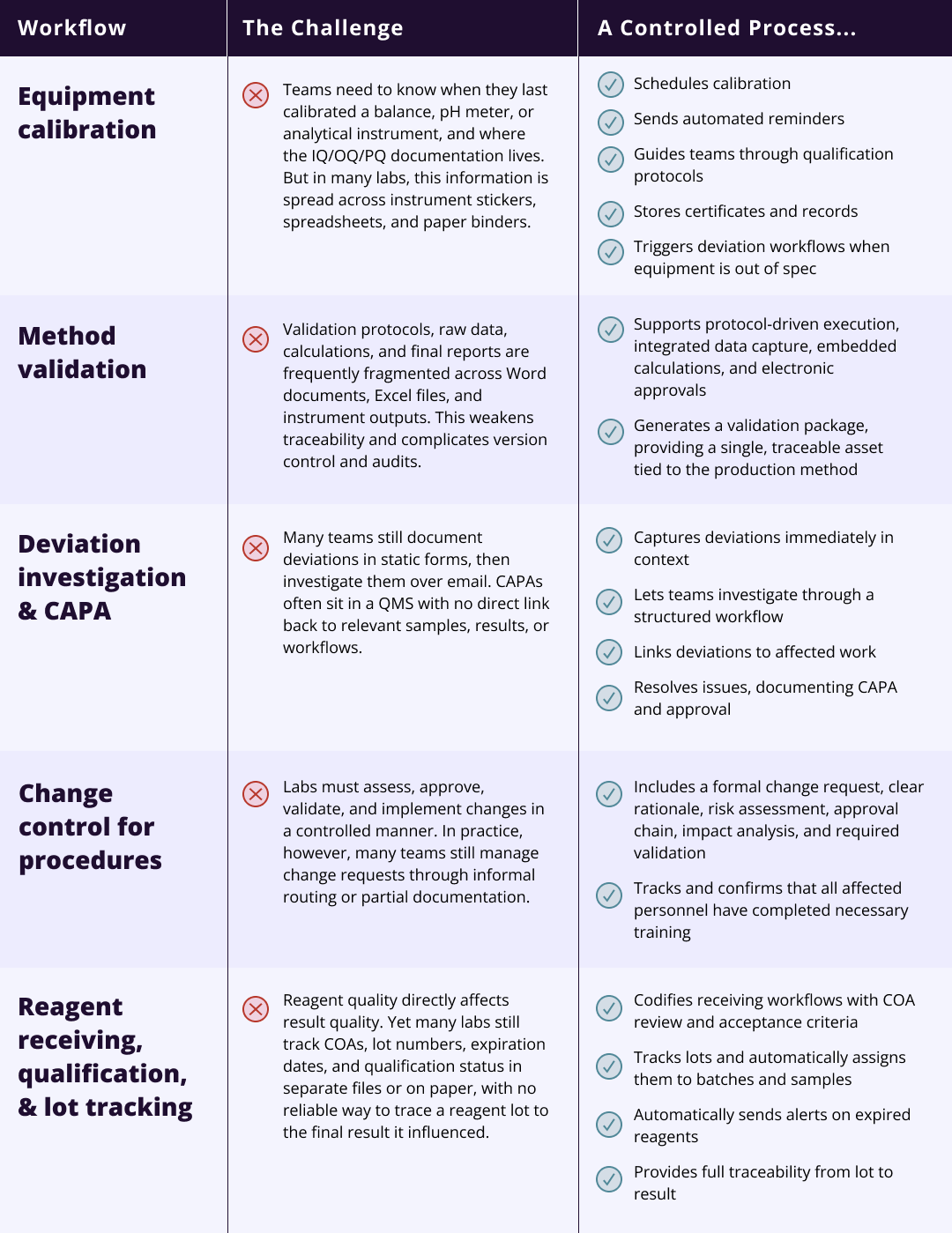
Many labs already have strong controls in place for sample and results management. But bringing these same controls to other workflows can feel overwhelming at first. The key is to not try fixing everything at once. Instead, start with the workflows that carry the highest compliance risk, are strong candidates for automation, and can be standardized without major disruption.
For many labs, the following five areas offer a great starting point.
Bring Every Workflow Under Control With Labbit
Labbit is built around the idea that the level of control applied to samples and results should extend to every workflow that supports them. At its core, Labbit is a modern laboratory informatics platform purpose-built for GxP-regulated environments. Rather than treating compliance as a one-time validation event, Labbit embeds GxP controls and automation into the system architecture itself. Every workflow built in Labbit is, by default, a controlled process.
With Labbit, teams no longer need to manage auxiliary workflows in disconnected spreadsheets, paper forms, or separate systems like QMS. Everything runs inside the same validated environment, with a single audit trail.
Here's how Labbit can handle each of the five high-priority workflows listed above:
- Equipment calibration and qualification: In Labbit, equipment is a first-class object. Teams can manage the full instrument lifecycle (scheduling calibration, executing qualification protocols, and storing IQ/OQ/PQ documentation) within the same validated environment samples and results. If a piece of equipment falls out of spec, Labbit automatically places affected samples on hold and triggers the appropriate deviation workflow, closing the loop without manual intervention.
- Method validation: Labbit turns validation studies into structured, executable workflows. Teams can run studies with embedded calculations, real-time data capture, and version-controlled protocols. At the end, Labbit automatically generates a complete validation package, creating a traceable, inspection-ready record from day one. Teams no longer have to scramble assembling reports across PDFs and excel files before an audit.
- Deviation investigation and CAPA: Deviations in Labbit are captured in context, exactly when and where the issue arises. Labbit links each deviation to the affected work, routes the investigation through a structured workflow with defined steps and approvals, and tracks CAPA completion through configurable dashboards.
- Change control for procedures: Labbit can integrate change control directly with method and procedure records so that when a change is initiated, Labbit triggers validation activities and automatically assigns required training to relevant personnel. The change isn't marked complete until every prerequisite is satisfied. Gaps that slip through in email-based approval processes simply can't happen in Labbit.
- Reagent receiving, qualification, and lot tracking: Labbit tracks the full reagent lifecycle: receiving, COA review and storage, qualification, lot assignment, and expiration alerts. Every reagent lot is automatically linked to the results it influenced, so if a lot is recalled or fails QC after the fact, identifying affected samples takes seconds rather than days.
Ready To Close The GxP Gap?
If your lab has strong controls for sample and results management but still relies on paper or spreadsheets for the workflows around them, now is the time to bring control and automation to your lab. Schedule a demo to see compliance in action on the Labbit platform.
1 U.S. Food and Drug Administration, Form FDA 483 Inspection Observations Summary (FY2022; FY2025), observation counts for 21 CFR 211.68(b).
Watch the recording of Configuration Versioning for LIMS: Bringing Software-Style Releases to Laboratory Systems to see how regulated labs can move beyond basic change tracking and manage configuration updates as structured, versioned releases—making system evolution transparent, controlled, and far easier to validate. You’ll learn why traditional LIMS change management falls short, how configuration versioning reduces validation burden by shrinking and structuring change scope, and how labs can safely deploy incremental updates without disrupting operations. The session also covers how this approach improves visibility into system changes, strengthens compliance, and enables faster, lower-risk continuous improvement.

In Part 2, Configuration Versioning and Validation: Managing Compliant LIMS Change, live on July 29, 2026 from 10:00–10:45 AM, Scott Krieger picks the conversation back up — moving from the mechanics of change management into validation governance itself. He'll dig into how structured, versioned changesets let teams define validated system state, scope impact assessments with precision, and build audit-defensible narratives grounded in configuration versions rather than ad hoc change. It's the natural extension of everything he described here: not testing less, but validating with clarity instead of fear.