
Cell & gene Therapy LIMS
Built to Enforce GMP in Regulated Cell & Gene Therapy Operations
Labbit is the graph-native, workflow-first platform that unifies execution and compliance for cell and gene therapy by capturing every relationship as work happens for faster decisions and stronger compliance.
Trusted By






Cell & Gene Therapy Manufacturing Requires a Different Kind of LIMS
Cell and gene therapy manufacturing demands precise execution, complete traceability, and ongoing validation through change. Traditional LIMS often require custom code and significant validation effort to keep pace.
Labbit’s graph-native architecture connects patients, materials, samples, equipment, and quality events into a traceable, auditable data model. Version-controlled workflows and configuration changes help teams manage updates within a validated framework—without relying on developers.
Key Benefits for Cell & Gene Therapy
Flexibility Without the Validation Tax
By separating configuration and platform versions, workflow changes, new fields, and updated process parameters stay within the validated envelope. Teams can scope exactly which parts of the system were impacted, limiting revalidation to only what changed, not the system as a whole.
Traceable By Design, Not Through Reconstruction
Every action, every signature, every change is captured as a native property of the data—not assembled from separate log tables after the fact. That includes not just who did what and when, but the context, conditions, and sequence that explain why and how.
Compliance Enforced at the Decision Point
Labbit enforces compliance at the point of execution, through your SOPs, not around them. Invalid materials are blocked before use, workflow progression is gated on required approvals and open deviations, and e-signatures are enforced within controlled steps. Non-conformances are caught before they occur, not recorded and investigated later.
From Event to Full Context, Instantly
When an out-of-specification result, contamination event, or reagent recall occurs, Labbit's connected graph model lets investigators quickly traverse from the event to complete chain-of-custody in a single navigation. The result is faster root cause analysis, more defensible CAPAs, and quicker decisions when product timelines are at risk.
Process Intelligence, Built Into the Foundation
Because Labbit captures relationships as a native property of the data, teams can explore process patterns, identify sources of variation, and answer new scientific and operational questions without first restructuring data. Faster process optimization, reduced variability, and a foundation for advanced analytics and AI, without data engineering overhead.
One Platform, From Clinical to Commercial
Most LIMS platforms work until you outgrow them. Labbit is designed for the full arc — configurable enough to support evolving IND-stage workflows, structured for the traceability and audit demands of pre-approval inspection, and extensible enough to scale with increasing patient volumes and manufacturing complexity through BLA approval and commercial launch.
Solutions for Every Cell & Gene Therapy Modality
AUTOLOGOUS CELL THERAPY MANUFACTURING (CAR-T, TIL, TCR)
Complete Provenance for Patient-Specific Manufacturing
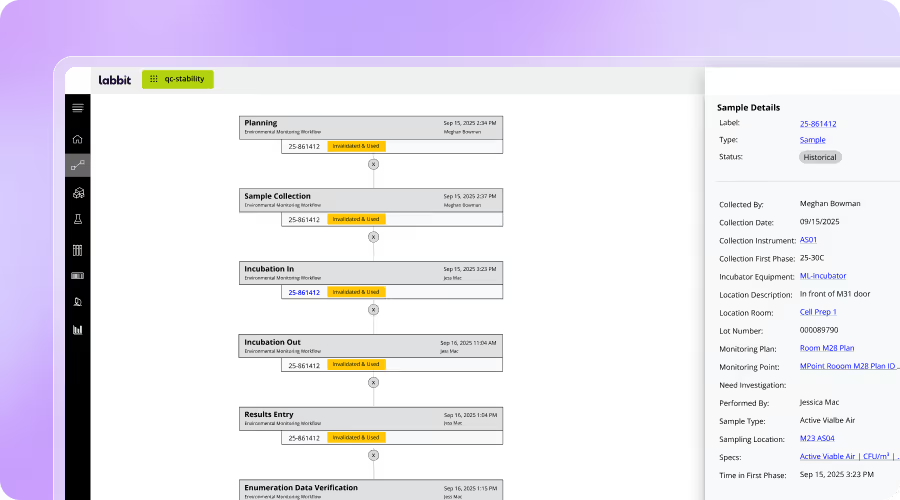
Labbit's graph-native data model captures chain-of-identity from apheresis to product release as a structural property of the data — linking patient, material, sample, operator, and quality event across every manufacturing step. Credential-backed e-signatures, real-time EM deviation flagging, and guided workflow enforcement ensure every action is captured in context at the point of execution. The result is an unbroken, inspection-ready record for every patient lot, without reconstruction and without the validation overhead legacy LIMS platforms add to every change.
VIRAL VECTOR & GENE THERAPY MANUFACTURING (AAV, LENTIVIRAL, CRISPR)
Controlled Evolution of Complex Gene Therapy Processes
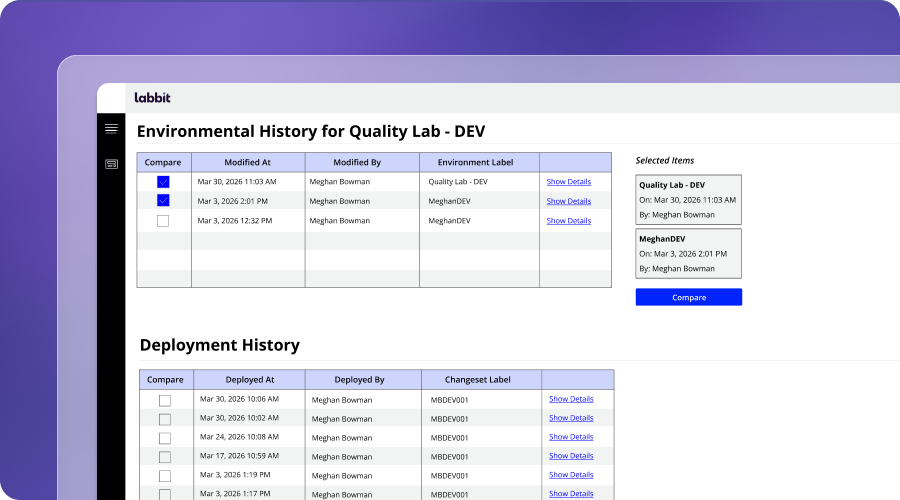
Labbit's entity-centric model links plasmid to vector to patient dose as connected, traceable data, while structured workflows handle the complex branching, handoffs, and conditional routing multi-step vector manufacturing requires. As programs progress from clinical development through technology transfer and scale-up, assays and process parameters can be updated within a governed, validated framework. And because every configuration change is versioned and impact-scoped, teams can identify exactly what changed and limit revalidation to only what was affected.
ALLOGENEIC CELL THERAPY MANUFACTURING & IPSC-DERIVED PRODUCTS
Consistency and Lineage at Commercial Scale
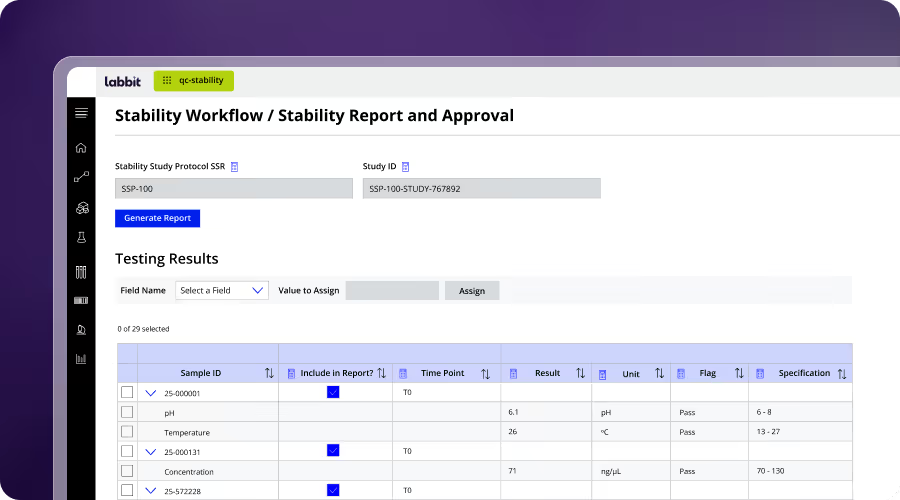
From donor material through master and working cell banks, expansion, and differentiation, Labbit captures each stage as a connected record, giving teams the lineage visibility needed to demonstrate lot-to-lot consistency at scale. As release criteria are refined and production matures, workflows, assays, and process parameters stay adaptable without disrupting the validated state, so the system evolves alongside the program rather than against it.
CGT CONTRACT DEVELOPMENT & MANUFACTURING ORGANIZATIONS
A Single Platform for Multi-Client GMP Operations
Labbit’s multi-environment architecture isolates each client’s data while maintaining consistent execution across programs, and its configuration layer supports diverse sponsor workflows without bespoke builds or client-specific system variants. Because every client program carries its own inspection exposure, Labbit keeps each IND or BLA’s traceability and audit trail fully separable — a configurable foundation for CDMOs managing high variability across clients without compromising control, compliance, or operational consistency.
Key Features for Cell & Gene Therapy Labs
No-Code Workflow Configuration
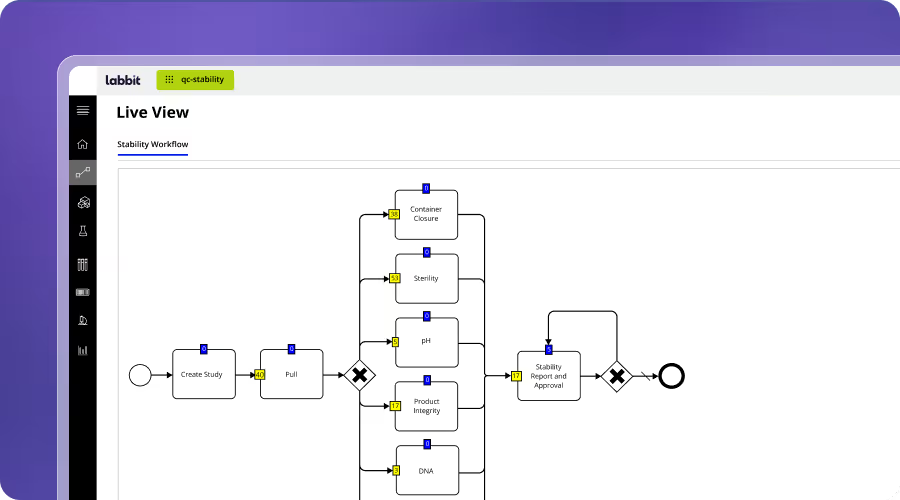
Build, modify, and version GMP workflows without custom code or developer involvement.
Chain-of-Identity and -Custody Traceability
Link patients, materials, samples, and process steps as connected, auditable data—from origin to release.
Electronic Batch Records
Execute guided, SOP-enforced batch records with point-of-action e-signatures and full operator attribution.
Separate Dev, Test, & Production Environments
Validate and stage configuration changes before they reach production, without disrupting live operations.
Instrument & Software Integrations
Seamlessly connect to instruments, equipment, and systems to automate data capture and ensure consistent data flow across the lab.
AI and Analytics-Ready Data Capture
Capture process, sample, and quality data as connected graph data — ready for analysis without restructuring
RElated resources
Insights for Cell & Gene Therapy Labs
Browse articles, webinars, and whitepapers that help cell and gene therapy teams evaluate and select the right LIMS while exploring best practices for maintaining compliance, managing change, and streamlining operations.
BLOG
Best LIMS for Cell & Gene Therapy Manufacturing
The right platform isn't the one with the longest feature list, it's the one that aligns with your lab's workflows, data model, regulatory requirements, and stage of growth.
case study
Preparing Cell and Gene Therapy GMP Operations for Scale
As a clinical-stage cell and gene therapy company prepared for commercial scale, its paper-based GMP processes could no longer keep pace with growing operational complexity and regulatory requirements. The company chose Labbit to digitize QC and manufacturing workflows, connect critical data, and create a flexible, scalable foundation for future growth.
Guide
Choosing A LIMS for Cell & Gene Therapy: A Buyer's Guide
Learn how to evaluate LIMS platforms for cell and gene therapy manufacturing, including the capabilities needed to support traceability, compliance, and evolving laboratory operations.
Solution brief
Cell & Gene Therapy Manufacturing LIMS
Read how Labbit supports cell and gene therapy manufacturing with its graph-native platform designed to enforce GMP, deliver chain-of-identity traceability, and give teams the flexibility to adapt workflows without the validation tax.

webinar
Why Graph Architecture is the Ideal Foundation for LIMS in GMP Manufacturing
GMP manufacturing generates complex relationships between materials, samples, batches, equipment, processes, and quality events. Learn how graph architecture can connect this information to improve provenance, accelerate investigations, simplify change management, and create a foundation for FAIR data and AI.
Regulatory Compliance + Data Security
Labbit's dedicated-instance architecture isolates each organization's data at the database level delivering complete, provable separation your team can stand behind in any security review. SSO and MFA run through your own identity provider, and you control your own upgrade timing, so authentication, change control, and configuration stay under IT ownership. API-first integrations keep connections clean, documented, and resilient to version changes.

Getting Started
See how Labbit works for labs like yours
Book a 30-minute demo to see visual workflow modeling, real-time execution visibility, and knowledge graph insights in action. We'll show you how Labbit adapts to your specific workflows — without the vendor lock-in.