Labbit vs LabWare

Trying to decide between Labbit and LabWare? 

The most important question isn't whether LabWare can do what you need — it's what it takes to make it do that, and what happens when your needs change. 

Here's an honest look at where the two systems differ.

LABBIT VS LABWARE

A Side By Side Comparison

LabWare can be configured to meet complex lab requirements, but the effort required to implement, change, and maintain that configuration has implications for how quickly labs can adapt, how completely they can trace sample history, and how readily they can put their data to work.

LabWare

Implementation & Time-to-Value

Setup requires configuration through its built-in scripting language, which can extend timelines and increase costs depending on the scope of customization required and the availability of skilled technical resources.
Utilizes visual, no-code design tools, configurable workflow templates, and an AI-powered configuration assistant to accelerate implementation.

Configuration vs. Customization

The line between configuration and customization is thin. Most workflow changes require LIMS Basic scripting, meaning routine adjustments carry the overhead of software development regardless of their complexity.
The BPMN-based configuration layer sits above the validated core, giving lab teams direct control over workflows without writing code. Configuration stays configuration — it never becomes a development project.

Change Management & Upgrade Risk

Configuration lives inside the database, which means upgrades frequently conflict with existing customizations. Reconciling what broke, what needs to be rewritten, and what requires revalidation is a recurring cost with each new release.
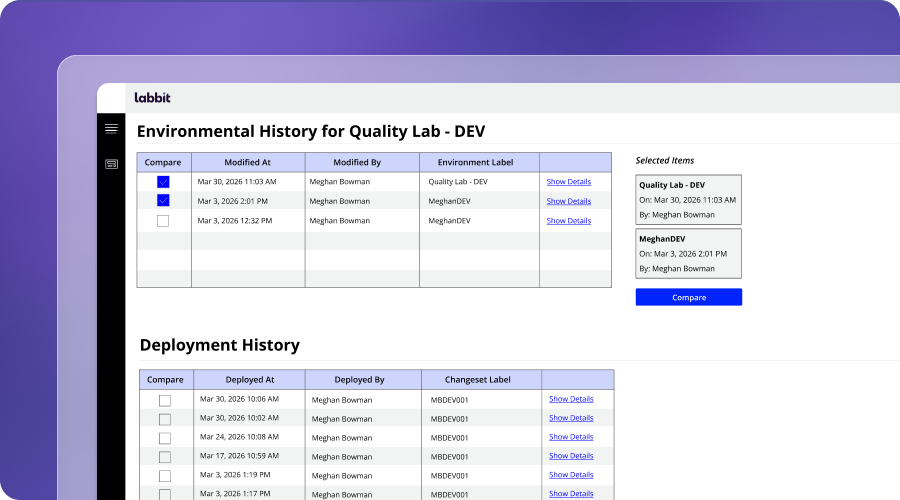
Every change is bundled into a versioned changeset, isolated above the validated core. Revalidation scope is limited to what was actually touched and upgrades don't disturb what wasn't.

User Experience

LabWare's interface can vary in layout and design across modules, and some users find it difficult to navigate between screens built for different lab scenarios, each with its own nomenclature and design logic.
Tasks in Labbit are supported by screens designed around the specific work being performed, presented in familiar language with steps laid out intuitively for the lab environment. Analysts see only what's relevant to their current step — the right fields, the right actions, nothing more.

Data Architecture & Analytics Readiness

Table-based architecture stores data in disconnected records. Connections between samples, workflows, and results have to be assembled through queries and custom scripting, making reporting, analytics, and AI tooling more complex to build and maintain.
Graph-native architecture stores relationships between samples, workflows, and results as direct connections in the data model, not as something that has to be assembled through queries. Reporting, audit traversal, and AI integration are fast by design because the data model was built for connected querying, not retrofitted for it.

Regulatory Compliance

LabWare can meet compliance requirements, but traceability depends on how the system was scripted during implementation. A complete sample lineage isn't a native output, it's a reconstruction, the quality of which reflects the choices made when the system was built.
Complete audit trails are captured automatically because relationships are native to the data model. Every step, decision, and result is part of a connected, immutable record, immediately traversable without reconstruction or custom scripting.

Why do labs choose Labbit over LabWare?

Faster implementation timelines

LabWare's scripting-based configuration model means implementation is a development project by nature — complex to scope and time-consuming to build. Labbit's visual workflow tools, configurable templates, and AI-powered configuration assistant are designed to compress that timeline, making it faster to get from requirements to a working system regardless of who's doing the configuring.

Configuration change enablement

LabWare is highly configurable to the unique requirements of a lab. It's what happens after implementation that creates friction. Configuration is stored in the database, and changes lack the guardrails needed to manage them safely over time, meaning any update to a workflow or a new version of the software can become a significant development project. Labbit's configuration layer is designed for change from the outset — versioned, isolated from the validated core, and updatable without the overhead of a full development cycle.

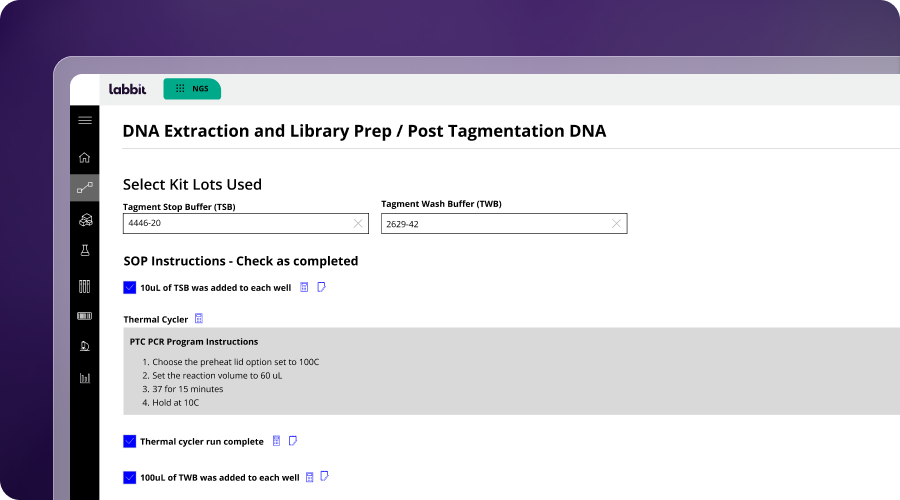
Digital form interface titled DNA Extraction and Library Prep/Post Tagmentation DNA displaying selectable kit lot numbers, SOP checklist with checked steps, and thermal cycler PCR program instructions.

Traceability without reconstruction

When an auditor asks for the full history of a sample, the answer in LabWare depends on what was instrumented during implementation. If a workflow wasn't configured to capture something, it isn't there. In Labbit, traceability isn't a configuration choice — it's a function of the data model. Every connection is recorded automatically, making the complete record of any sample immediately accessible.

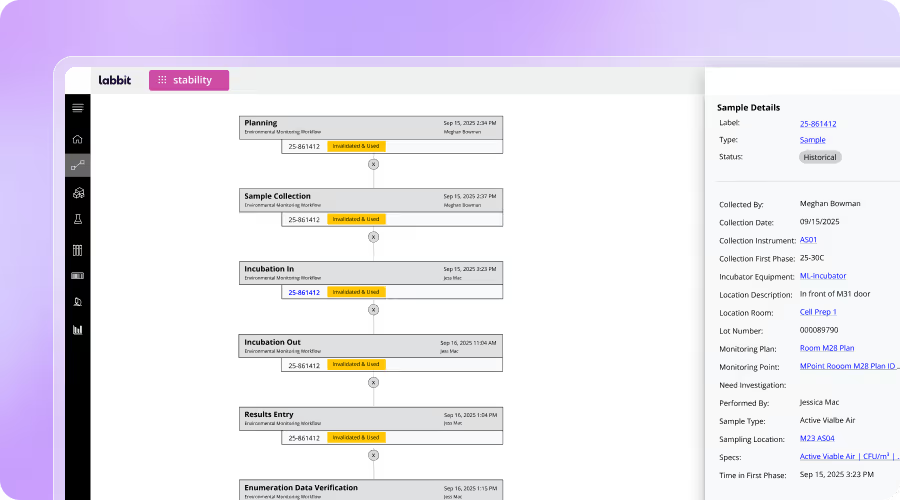
User interface of Labbit software showing a pharmaceutical environmental monitoring workflow with steps like Planning, Sample Collection, Incubation In, Incubation Out, and Results Entry, each marked as Invalidated & Used, alongside sample details including label, type, status, collection and monitoring information.

"When we saw how Labbit works, it was clear how thoughtfully they built the system to address the challenges their customers had encountered with other LIMS."

John ten Bosch
VP of Laboratory Operations, BillionToOne

"With a Next-Generation LIMS like Labbit, the high amount of money and effort ultimately wasted when a LIMS solution never gets deployed or adopted may become a problem of the past."

John Conway
Chief Visioneer, 20 / 15 Visioneers

“Labbit empowered us to transcend the traditional trade-offs between advanced features the commercial side of the business wants and the user experience that our laboratorians require.”

Ronak Kadakia
COO, LinusBio

“That’s what stood out when evaluating Labbit—that this LIMS could finally achieve all of our needs with one solution.”

Tyler Cassens
Senior Product Manager, Helix

Frequently Asked Questions

What is the main difference between Labbit and LabWare?

Labbit is a modern, workflow-driven LIMS built for labs that need to configure, validate, and evolve their systems without depending on developers or accumulating technical debt. LabWare offers deep configurability but that configurability runs through LIMS Basic scripting, meaning every meaningful change carries the overhead of software development.

How does LabWare handle system upgrades, and how does that compare to Labbit? 

LabWare’s configuration lives inside the database, which means upgrades can break existing scripting. Reconciling what changed — and what now needs to be rewritten and revalidated — is a significant recurring tax. Labbit’s configuration layer sits above the validated core and is version-controlled independently. Upgrades are predictable because the configuration layer doesn’t intermingle with the underlying system, and revalidation scope is limited to what actually changed.

How does Labbit's audit trail compare to LabWare's?

In a regulated lab audit, the most common requirement is demonstrating the complete history of a specific sample — every step, every decision, every result, from receipt to release. In LabWare, traceability depends on how the system was configured to track data during implementation, meaning the completeness of an audit trail reflects choices made when the system was originally built, and depending on those choices, some trails may need to be reconstructed rather than retrieved. Labbit approaches this differently. Because relationships between samples, workflows, and results are inherently part of the graph data model, the full audit story of any individual sample is readily accessible and traversable without reconstruction.

How does Labbit's data model compare to LabWare's for analytics and AI?

Labbit's graph-based data model natively captures relationships between samples, workflows, and results as direct connections, giving AI tools and analytics the connected context they need without requiring a separate abstraction layer or additional data preparation. LabWare's table-based architecture stores relationships as implicit joins, meaning surfacing connections for reporting or AI tooling may require custom development that Labbit makes available by default.

Is Labbit suitable for regulated lab environments?

Yes. Labbit is SOC 2 certified and supports compliance with 21 CFR Part 11, ISO 17025, CAP/CLIA, HIPAA, and GDPR. Its graph-based audit trails capture all data, metadata, and relationships natively and immutably.

Abstract flowing waves in shades of purple and violet creating a smooth, dynamic texture.

GETTING STARTED

See how Labbit works for labs like yours

Book a 30-minute demo to see visual workflow modeling, real-time execution visibility, and knowledge graph insights in action. We'll show you how Labbit adapts to your specific workflows — without the vendor lock-in.