
In most labs today, systems document what should happen and what actually happened as two separate elements. Because intent (a designed workflow) and execution (an executed workflow) are independent, it can be difficult to prove whether the two are the same or if they diverge. While this separation is so common in traditional lab systems that it feels inevitable, it shouldn’t be. It’s a lab system modeling choice, and a costly one.
A better option is to implement a modern informatics system, such as Labbit, which is built on the concept of structurally binding workflow intent to execution. This approach enables labs to transform their workflows into verifiable execution contracts and executed work into native provenance.
The Hidden Split In Most Lab Systems — Workflow Intent vs Execution
Nearly every lab system treats intended workflows and the actual execution of workflows as independent concerns.
- Intent: Is documented in protocols, standard operating procedures (SOPs), workflow diagrams, training materials, and checklists.
- Execution: Is captured in electronic lab notebooks (ELNs), laboratory information management systems (LIMS) event records, instrument logs, files and folders with timestamps, spreadsheets, and human-written notes.
The connection between these two elements is informal or implied. A run is “based on” a protocol, while a record “corresponds to” a workflow step.
The lack of a structural link is immediately clear in cases where deviations occur, data must be trusted, or workflows evolve. Validation or auditing becomes a forensic analysis of what the lab planned versus what happened, with humans asked to narrate how the execution matched the intended workflow. Provenance is a narrative rather than a recorded fact.
Why Most Lab Workflows Are Generally Treated As Documentation
Most laboratory tasks are guided by workflows in the form of written instructions or flowcharts. To ensure these workflows are systematic and reproducible, some labs use workflow modeling languages like Business Process Model Notation (BPMN) to visualize and document their processes.
These tools help lab staff capture task order, decision points, parallelism, and handoffs, and are useful for designing and managing complex lab processes. But in many labs, the use of BPMN ends with documentation — the diagram simply describes the workflow.
Execution systems may loosely reference the diagram, but they do not enforce its structure. Tasks can be skipped, merged, reinterpreted, or executed out of order without leaving a structural trace. The workflow illustrates what should happen, but it cannot control how a task is actually executed.
In regulated, high-stakes laboratory environments, however, a workflow should be a contract: a precise declaration of the work that can occur, in what structure, and with what dependencies.
Labbit’s Approach Is To Use BPMN To Bind Intent To Execution
Labbit’s central idea is that intent and execution should not be linked narratively — they should be bound structurally. In Labbit:
- A BPMN workflow is not an external reference.
- Each BPMN task defines an executable slot in the workflow, with specified inputs, outputs, and control flow.
- That slot is bound to a concrete execution artifact: a workbook, which contains the entire workflow as executed.
When work is performed, it is not merely “associated with” a task. It is executed inside the task defined by the BPMN workflow. The relationship between the intent and the execution is explicit, durable, and machine-readable, and cannot be retroactively reinterpreted. Deviations are no longer ambiguous. If execution occurs outside the defined structure, it is visible. If steps are skipped or repeated, it is evident in the workbook.
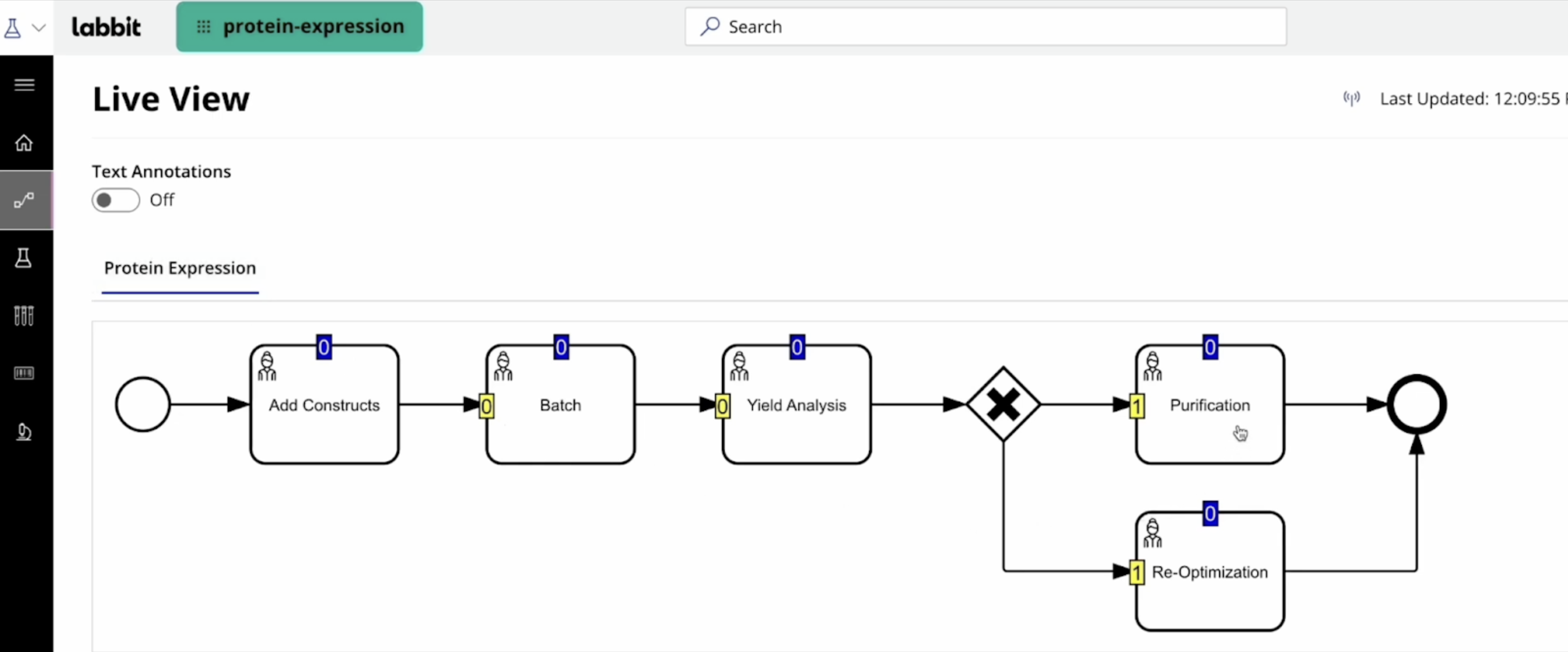
Labbit includes a library of preconfigured BPMN workflows and tasks for common workflows. It also has an AI-driven configuration assistant to help your lab staff with workflow and task creation.
Using BPMN As A Verifiable Execution Contract Means Provenance Is Structural
Traditionally, provenance in a lab has been a narrative of data changes that is reconstructed after the fact. Systems collect logs, timestamps, file paths, and human-written descriptions, then attempt to piece together what happened. This creates provenance that is expensive to validate, vulnerable to interpretation, and dependent on human accuracy.
Labbit’s approach uses BPMN as a verifiable execution contract and records provenance as the workflow is executed. Workbooks store provenance in a graph database defined by PROV-O, the PROV ontology from W3C, with the BPMN task, execution, and actor mapping to the PROV-O activity, entity, and agent.
Because execution is bound to workflow tasks, the recorded provenance already knows why a step occurred, what preceded it, and what it produced. No narrative is required because the structure itself is the record.
Validation Emerges Naturally From Binding Intent And Execution Together
When intent and execution are structurally bound, validation no longer requires a separate activity. There is no need to ask, “Did this follow the workflow?” because the answer is encoded in the structure.
Your lab can instantly see:
- The workflow that was run.
- The tasks that were executed.
- Where execution aligned or diverged from intent.
Binding intent and execution removes ambiguity. The system does not need to infer workflow or regulatory compliance. It can demonstrate it.
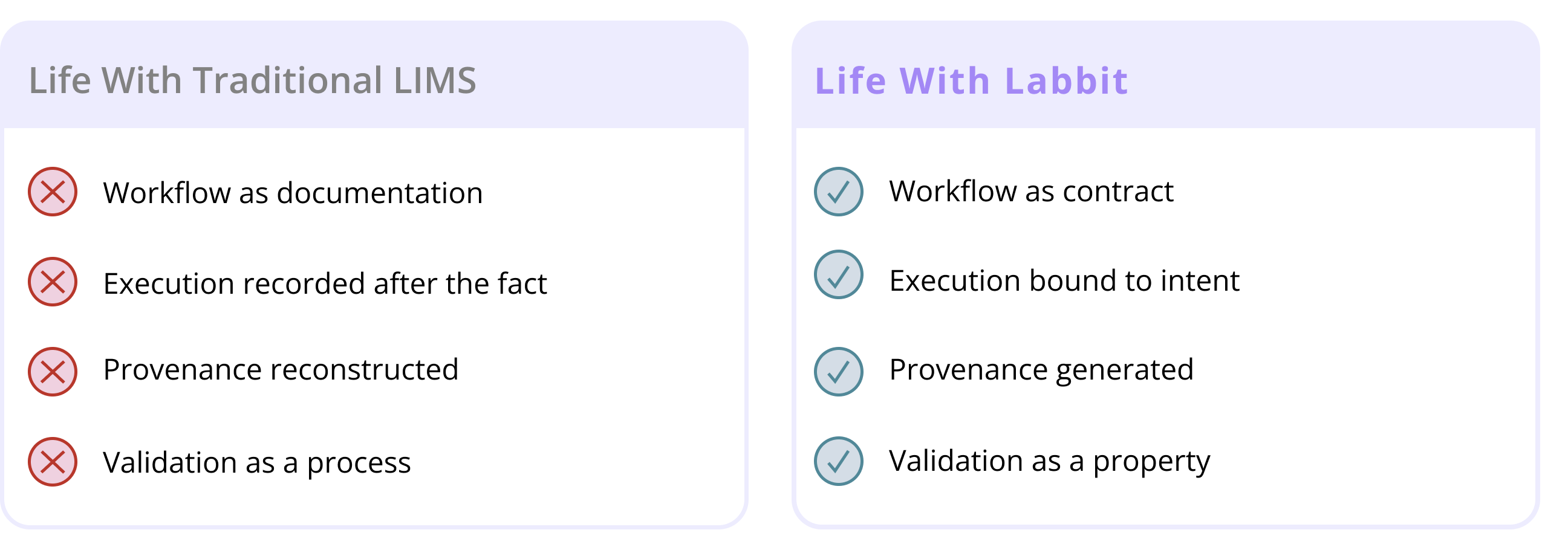
Labbit vs A Traditional LIMS: What’s Structurally Different
A traditional LIMS can be excellent at record-keeping. It can log events, store results, and track samples. But fundamentally, it treats workflows as configuration and provenance as reconstruction.
Labbit inverts that model by using a different underlying architectural structure to make intent and execution inseparable.
Transform Your Diagrams Into Executable Reality
When labs treat workflows as diagrams, drift is inevitable. Reality slowly diverges from intent, and the gap is filled with explanations. But when you treat workflows as contracts, that gap disappears. Execution becomes accountable by default, provenance becomes structural, and trust becomes computable.
Labbit makes this shift possible at an architectural level. Leveraging BPMN and graph databases, it can help your lab move from describing work to defining it, and from recording events to binding reality to intent.
When workflows are contracts and execution is provenance, “what your lab planned” and “what your lab did” are no longer separate elements. They are structurally the same. The result for your lab? Less effort on auditing and validation tasks, lower risk of regulatory non-compliance, and more time and resources to invest in scientific innovation.
If your lab would like to stop validating paperwork and start validating the execution of workflows, book a quick call with us.